Reverse osmosis
Which tankless reverse osmosis system should you buy?
Quick answer
A tankless reverse osmosis system trades the four gallon tank for mains electricity and a much higher rated membrane, and the Waterdrop G3P600 at 600 GPD with a roughly 2 to 1 pure to drain ratio is the right size for most households that want cabinet space back without waiting on a slow fill.
A tankless reverse osmosis system produces water on demand from a membrane rated many times higher than a conventional system, rather than storing pretreated water in a pressurized tank ahead of time. That trade buys back the cabinet floor space a 4 gallon tank takes up, improves the drain ratio because there is no tank to keep topped off, and requires an electrical outlet under the sink that a conventional system never needs.
The systems below are compared on published rated GPD, drain ratio and stage count, checked against verified owner reviews for the fill speed and noise complaints a spec sheet omits. Nothing here was installed to test it. A tankless system is not automatically the better choice; it solves specific problems, cabinet space and drain ratio, that a conventional tank system does not have in the first place.
On this page
What actually changes when there is no tank?
A conventional system fills a tank slowly in the background and delivers stored water fast at the faucet; a tankless system reverses that, producing water at membrane speed the moment the faucet opens, which is why the rated membrane is so much higher, several hundred GPD instead of 50 to 90. Removing the tank also removes the air charge that a conventional system depends on, along with the maintenance and troubleshooting that goes with it.
The cost of that trade is mains electricity under the sink and a somewhat higher purchase price at the low end of the tankless range compared to a basic conventional system. Every tankless system on this page needs an electrical outlet and, on some models, drilled holes for the faucet and display, which is worth confirming against the cabinet before ordering.
How we chose
Systems here were compared on published rated GPD, drain ratio and stage count, then checked against verified owner reviews for fill speed, noise and installation complaints a spec sheet does not show. Nothing on this page was installed or run to test it. Any certified claim is named with its NSF/ANSI standard number.
Beginner: the lowest cost entry into tankless
A first tankless system should solve the cabinet space problem without the highest membrane rating a household will never actually use, since a 400 GPD tankless unit already outproduces a conventional tank system at steady state.

Waterdrop G2 Tankless Reverse Osmosis System, 400 GPD
$249.99A 400 GPD membrane with a published 1 to 1 pure to drain ratio, well below the cost of the larger units in this range.
Best for: A first tankless system where cabinet space is tight and price matters
Check price on AmazonIntermediate: enough output for most households
A 600 GPD membrane fills a glass at close to conventional tap speed for most households and includes a smart faucet that reports TDS and filter life, features the entry unit skips.

Waterdrop G3P600 Tankless Reverse Osmosis System, 600 GPD
$439.00A 600 GPD membrane with a published roughly 2 to 1 pure to drain ratio and a smart display faucet with a TDS monitor.
Best for: A small under sink cabinet, or a household that wants no storage tank at all
Check price on AmazonExpert: the fastest fill in this range
An 800 GPD membrane is aimed at households that have already found every other reverse osmosis system too slow, whether tank based or tankless, and are willing to pay for the ceiling rather than the typical case.
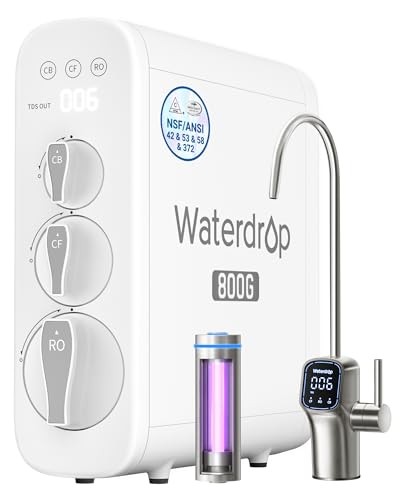
Waterdrop G3P800 Tankless Reverse Osmosis System, 800 GPD
$849.00An 800 GPD membrane, the highest rated unit in this range, with a published roughly 3 to 1 pure to drain ratio.
Best for: A household that finds every other reverse osmosis system too slow
Check price on AmazonWho should not buy this tier: A one or two person household, where a 400 GPD unit already produces faster than actual demand and costs considerably less. The extra output on an 800 GPD membrane is wasted on a small household.
Does the drain ratio actually change between tankless models?
Yes, and it is worth reading the specific published ratio rather than assuming tankless automatically means the same number across brands. As a general convention, a conventional tank system recovers roughly 20 percent of feedwater, meaning about four gallons go to drain for every gallon produced; a permeate pump raises that to roughly a third; tankless systems are generally built for around half or better. The G3P600 publishes a roughly 2 to 1 pure to drain ratio on its own listing, and the G3P800 publishes roughly 3 to 1, both better than the general tankless convention because of their specific internal design. Drain water in every case is concentrate carrying away what the membrane rejected, not pure waste, and pushing recovery too high for a given membrane accelerates scaling on it.
Recovery runs from roughly 20 percent on a conventional tank system to 50 percent or better on tankless, as a general convention rather than a fixed figure.
Rule of thumb Water treatment trade convention rather than a published standard. Taught everywhere, useful for planning, and not a specification. No standards body publishes it.
| System type | Typical recovery | Typical drain ratio |
|---|---|---|
| Conventional tank | About 20 percent | Roughly 4 to 1 |
| Tank with permeate pump | About 33 percent | Roughly 2 to 1 |
| Tankless | About 50 percent or better | Roughly 1 to 1 or better |
These are trade conventions, not a certified figure. Check the specific published ratio for the exact model, since some tankless units beat the general convention noticeably.
A tankless system fills a glass faster; it does not tell you what was in the glass beforehand. Start from a Consumer Confidence Report on city water or a certified laboratory test on a well before choosing a rated membrane size, since none of these systems address bacteria, nitrate, lead, arsenic or PFAS unless the specific model carries that certified claim.
How we chose
We did not test this equipment in person and we never claim to. Picks are researched from manufacturer specification sheets, published standards and regulatory limits, and the recurring themes in verified owner reviews. Every pick is matched to a real grain capacity, a real micron rating, a real certified claim or a real flow rating rather than to a price bracket, and it is placed in the tier where its published capability actually belongs. We rejected the unbranded flood that dominates several of these search results, because a softener is a pressure vessel on the main line and a filter is the only thing between a contaminant and a glass of water, and neither is a place for a product with no parts channel and no service path. Where a figure is trade convention rather than a published standard we label it that way, and where a manufacturer does not publish a figure we leave it out instead of estimating it. Above all, we do not recommend equipment for a problem nobody has measured.
Frequently asked questions
What is the difference between a tankless and a tank reverse osmosis system?
A tankless system produces water on demand from a much higher rated membrane and needs mains electricity under the sink; a tank system stores pretreated water in a pressurized bladder tank and needs no power. Tankless saves cabinet floor space and improves the drain ratio; a tank system keeps working during a power outage and is generally the lower cost entry point.
Do tankless RO systems need electricity?
Yes, every tankless system on this page requires an electrical outlet under the sink, unlike a conventional tank system which needs none. Some models also require drilled holes in the countertop for a smart display faucet. Confirm outlet access and any drilling requirements against the specific cabinet before ordering, since retrofitting power under an existing sink can add real installation cost.
What GPD rating do I need for a tankless RO system?
400 GPD already outproduces a typical household's actual drinking water demand, since nothing is being stored for later use the way a tank does. Move up to 600 or 800 GPD specifically for faster fill speed at the faucet, not because a small household needs the extra volume. A larger household with several people using the tap at once benefits more from the higher rating.
Is the drain ratio really better on a tankless system?
Generally yes, as a trade convention tankless systems recover around half or more of feedwater, compared to roughly 20 percent on a conventional tank system, because there is no tank sitting idle between uses. The exact ratio varies by model, and some published figures beat the general convention, so check the specific rated ratio for the unit rather than assuming a fixed number.
Can a tankless RO system remove nitrate, arsenic or lead?
Only where the exact model carries a certified claim for that specific contaminant under NSF/ANSI 58, the same rule that applies to a tank based system. These contaminants are invisible and tasteless, so a certified laboratory test, and usually a licensed professional or the local health department, is the only way to confirm the level before assuming any reverse osmosis system has addressed it.
Is tankless reverse osmosis worth the extra cost?
Only if cabinet space or drain ratio is an actual problem being solved, since a basic conventional tank system does the core job, dissolved contaminant reduction, at a lower price and without needing an electrical outlet. A tight under sink cabinet or a strong objection to a conventional system's roughly four to one drain ratio are the two honest reasons to pay more for tankless.
Get the complete water treatment shopping list
Every item in the starter, complete and premium systems for both city water and well water, with running totals, in one printable list. It opens with the test kit, because that is genuinely the first purchase. No charge.
One list, no sequence of daily emails, and you can leave at any time.
Researched, not professional advice. This page is compiled from published standards, regulatory limits, manufacturer specifications and owner-review consensus, not hands-on testing. Nothing here diagnoses a water problem or says any product makes water safe to drink. Figures described as a rule of thumb are water treatment trade convention rather than published standards, and they are labeled that way wherever they appear. Test your water before you buy equipment: on city water start with the Consumer Confidence Report your utility publishes each year, and on a private well only a certified laboratory test tells you what you have. Bacteria, nitrate, lead, arsenic and PFAS are not do it yourself topics, they are invisible and tasteless, and they need a laboratory and usually a licensed professional rather than a product. Remember that a certification covers a specific claim under a specific standard, so "NSF certified" with no number attached tells you very little.