Softener sizing
Water softener salt calculator
Quick answer
A 48,000 grain softener on 15 grain water serving 4 people uses about 12.0 pounds of salt per regeneration and roughly 730 pounds a year at an efficient 8 pound setting. Running the same unit at a 15 pound dose buys more capacity per cycle at considerably worse efficiency.
Salt is the ongoing cost of owning a softener, and the setting that controls it is the one thing most owners never touch. The relationship is not linear: the last increment of capacity is bought very expensively in salt, and the curve is steep enough that the difference is worth understanding.
NSF/ANSI 44 sets 3,350 grains per pound of salt as the threshold for a high efficiency certification. That certification is earned at a particular salt setting, so a high efficiency softener programmed to a maximum dose is not running at high efficiency, whatever the box says.
Work out your own salt use
About 730 pounds of salt a year, or 18.3 bags, at 2,800 grains per pound.
| Figure | Value |
|---|---|
| Resin volume | 1.5 cu ft |
| Salt per regeneration | 12.0 lb |
| Days between regenerations | 6.0 |
| Regenerations per year | 61 |
| Salt per year | 730 lb |
| Bags per year | 18.3 |
| Salt efficiency | 2,800 grains per lb |
Shown with the example figures above. Change any field to run your own numbers.
The working
Rule of thumbresin cubic feet = nameplate grains / 32,000 salt per cycle = resin cubic feet x salt dose per cubic foot daily load = people x 80 x hardness days between = (working capacity - one day reserve) / daily load salt per year = (365 / days between) x salt per cycle
The resin capacity curve is published by resin manufacturers. The 80 gallons per person per day is trade convention. Water treatment trade convention rather than a published standard. Taught everywhere, useful for planning, and not a specification. No standards body publishes it.
Salt, resin and brine tank parts
Salt is almost always cheaper locally than shipped, because forty pound bags are mostly shipping cost. These are here for comparison and for the parts that are genuinely worth ordering.

AFWFilters 18 by 33 Inch Brine Tank with Safety Float Assembly
$209.00A full size brine tank with the safety float included, which is the part that stops a failed valve overflowing a tank of brine onto the floor.
Best for: Replacing a cracked or crusted brine tank
Check price on Amazon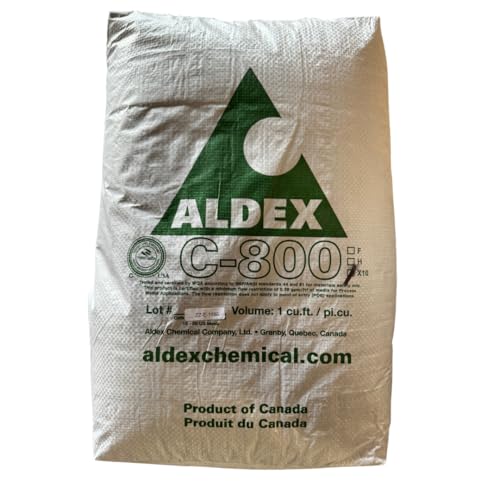
Aldex C800x10 10 Percent Crosslinked Water Softener Resin
$184.00Ten percent crosslinked resin, which resists oxidative damage from a chlorine residual and lasts materially longer on chlorinated city water.
Best for: City water with a noticeable chlorine residual
Check price on Amazon
Aldex C800 8 Percent Crosslinked Water Softener Resin, 1 Cubic Foot
$169.00Standard eight percent crosslinked cation resin from a named resin manufacturer, which is the baseline every capacity figure on this site is calculated against.
Best for: Rebedding a one cubic foot softener on non chlorinated or lightly chlorinated water
Check price on Amazon
Square Brine Tank for Water Softener, 11 by 11 by 38 Inch, with Safety Float
$152.25A narrow square footprint that fits where a round tank will not, with the brine safety float included.
Best for: A tight utility closet
Check price on Amazon
Morton Clean and Protect Water Softener Salt Pellets, 40 lb, 2 Pack
$35.00 Published specsMorton own listing rather than a repackager, at roughly half what the multipack resellers charge for the same pellets.
Check before buying: Softener salt is usually far cheaper per bag at a hardware store or grocery, because shipping forty pound bags dominates the online price.
Best for: Topping up a brine tank between grocery runs
Check price on Amazon
Diamond Crystal Bright and Soft Water Softener Salt Pellets, 50 lb
$34.95High purity evaporated salt pellets, which leave less insoluble residue in the brine tank than rock salt and so need the tank cleaned out less often.
Best for: Anyone tired of shovelling mush out of the bottom of a brine tank
Check price on AmazonEvery figure shown is the manufacturer own published specification. None of this is a recommendation for water you have not tested: the arithmetic above is only as good as the numbers you put into it, and on a private well those numbers come from a certified laboratory rather than from a chart.
The efficiency curve
Going from a 6 pound dose to 15 buys about 50 percent more capacity for 150 percent more salt, which is why the efficient setting wins over a year.
Published figure A published standard, regulatory limit, unit conversion or manufacturer specification. It does not change because somebody disagrees with it.
| Salt dose per cubic foot | Grains per cubic foot | Grains per pound of salt | Against NSF/ANSI 44 |
|---|---|---|---|
| 6 lb | 20,000 | 3,333 | Below the threshold |
| 8 lb | 22,400 | 2,800 | Below the threshold |
| 10 lb | 24,000 | 2,400 | Below the threshold |
| 12 lb | 27,000 | 2,250 | Below the threshold |
| 15 lb | 30,000 | 2,000 | Below the threshold |
Resin exchange capacity against salt dose is published by resin manufacturers for standard eight percent crosslinked resin. The 3,350 grains per pound figure is the NSF/ANSI 44 high efficiency threshold.
Where to actually buy salt
Almost always locally. Softener salt is forty to fifty pounds a bag and the shipping dominates the online price, frequently to the point where a multipack costs two or three times what the same pellets cost at a hardware store or a grocery. The listings here are for comparison rather than as a recommendation to ship bags.
What is worth choosing deliberately is the type. Evaporated pellets are higher purity and leave less insoluble residue in the brine tank, which means cleaning it out less often. Rock salt is cheapest and leaves the most. Solar salt sits between them.
Why the brine tank holds water
A regeneration ends by metering water back into the salt tank to dissolve salt for the next cycle, so a few inches of water in the bottom between regenerations is normal and expected. People open the lid, see water and assume a fault.
What is not normal is water near the top, salt that has set into a solid crust with a cavity under it, or a tank that is still full of salt while the water has stopped softening. Those are a bridged tank, a stuck float or a failing valve respectively.
Frequently asked questions
How much salt should a water softener use per month?
It depends on hardness, household size and the salt setting rather than on the softener alone. A 48,000 grain unit on 15 grain water with 4 people uses roughly 61 pounds a month at an efficient setting, which is about one bag. Double the hardness and it roughly doubles.
Can I save money by turning the salt setting down?
Yes, within the range your manufacturer supports, and it genuinely improves efficiency. What it also does is cut capacity per cycle, so the unit regenerates more often. If that drops below about three days between cycles you have traded a salt saving for more water down the drain and faster resin wear, which is not a saving.
What kind of salt is best?
Evaporated pellets are the highest purity and leave the least insoluble residue, so the brine tank needs cleaning out less often. Rock salt is cheapest and leaves the most sediment. Potassium chloride is an alternative for people reducing sodium intake, but it costs several times as much and is typically dosed higher for the same result.
Why is there water in my brine tank?
Because a regeneration ends by metering water back in to dissolve salt for the next cycle, so a few inches in the bottom is normal. Water near the top, or salt set into a solid crust with a cavity underneath, is not: those point at a bridged tank, a stuck safety float or a control valve that is not drawing brine properly.
Does softened water make my water salty?
Ion exchange swaps calcium and magnesium for sodium, so softened water carries more sodium than the raw water did, in proportion to the hardness removed. At ordinary residential hardness the amount is small relative to dietary sources, but anyone on a medically restricted sodium intake should discuss it with their doctor and consider a separate unsoftened drinking tap.
Does high efficiency mean it uses less salt automatically?
No, and this is the most commonly misread thing about a softener. NSF/ANSI 44 certifies high efficiency at 3,350 grains per pound, earned at a specific salt setting. A certified unit programmed to a maximum dose delivers the same poor efficiency as any other softener at that dose. The setting is what does the work.
Get the complete water treatment shopping list
Every item in the starter, complete and premium systems for both city water and well water, with running totals, in one printable list. It opens with the test kit, because that is genuinely the first purchase. No charge.
One list, no sequence of daily emails, and you can leave at any time.
Researched, not professional advice. This page is compiled from published standards, regulatory limits, manufacturer specifications and owner-review consensus, not hands-on testing. Nothing here diagnoses a water problem or says any product makes water safe to drink. Figures described as a rule of thumb are water treatment trade convention rather than published standards, and they are labeled that way wherever they appear. Test your water before you buy equipment: on city water start with the Consumer Confidence Report your utility publishes each year, and on a private well only a certified laboratory test tells you what you have. Bacteria, nitrate, lead, arsenic and PFAS are not do it yourself topics, they are invisible and tasteless, and they need a laboratory and usually a licensed professional rather than a product. Remember that a certification covers a specific claim under a specific standard, so "NSF certified" with no number attached tells you very little.