Flow rate
Whole house water flow rate calculator
Quick answer
A 2 bathroom home with 4 people plans for roughly 8 gallons per minute of peak simultaneous demand. That calls for a standard 20 inch housing taking a 2.5 x 20 in cartridge, because a whole house filter is sized on peak flow rather than on daily use.
A whole house filter is sized on peak flow, not on how much water the household uses in a day, and the failure mode is specific: a filter that cannot pass enough water chokes the whole house. The symptom is a shower that loses pressure the moment somebody starts the washing machine, and it gets blamed on the pump, the pressure regulator and the municipal supply long before anyone checks the filter.
Peak flow is decided by fixtures rather than by people, which is why bathroom count is what the trade and every manufacturer specification sheet sizes on.
Work out your own peak flow
A 2 bathroom, 4 person home needs about 8 GPM, which a standard 20 inch housing passes.
| Figure | Value |
|---|---|
| Bathroom count figure | 8 GPM |
| Household allowance | 0 GPM |
| Peak demand | 8 GPM |
| Housing that fits | Standard 20 inch |
| Cartridge size | 2.5 x 20 in |
Shown with the example figures above. Change any field to run your own numbers.
The working
Rule of thumbpeak demand = trade figure for the bathroom count + 1 GPM for every 2 people above 4 housing that fits = the smallest whose typical maximum flow covers it
Fixture flow maximums are published federal figures. Sizing by bathroom count is water treatment trade convention rather than a standard. Water treatment trade convention rather than a published standard. Taught everywhere, useful for planning, and not a specification. No standards body publishes it.
Housings and systems that pass this flow
Sized on peak flow rather than on household size. The cartridge inside the housing is the real restriction, so a finer rating always passes less than a coarse one of the same physical size.

iSpring WGB32BM Iron and Manganese 3 Stage Whole House Water Filter System
$473.68The same three stage platform with an iron and manganese reducing cartridge in place of one carbon stage.
Check before buying: A cartridge filter handles only a low iron level and plugs quickly above it. Above roughly 3 ppm this is the wrong machine and a backwashing iron filter is the right one.
Best for: Well water with a low measured iron level, well under what needs a backwashing filter
Check price on Amazon
iSpring WGB32B 3 Stage Whole House Water Filter System
$420.00 Published specsThe reference three stage big blue system: sediment, then two carbon block stages, on one inch ports with a published service flow.
Best for: City water with a chlorine taste complaint and some particulate
Check price on Amazon
Pentair Pentek BBFS-222 Big Blue Three Housing Filtration System, 1 Inch NPT
$350.75 Published specsThree big blue housings pre mounted on a bracket, which is the staged sediment and carbon arrangement most whole house systems are trying to be.
Best for: A well water installation needing genuine coarse to fine staging plus carbon
Check price on Amazon
iSpring WGB22B 2 Stage Whole House Water Filtration System
$286.70Sediment plus carbon block in the 20 by 4.5 inch big blue format, which is the size that actually passes whole house flow without a pressure complaint.
Best for: A straightforward city water taste and particulate job
Check price on Amazon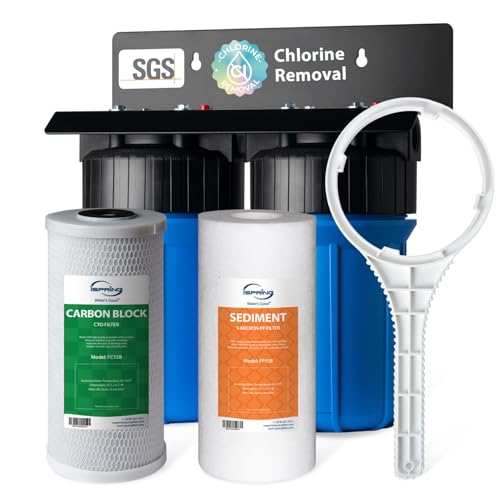
iSpring WGB21B 2 Stage Whole House Water Filtration System, 50,000 Gallons
$155.99The lowest cost entry into two stage whole house filtration, with a published 50,000 gallon capacity.
Best for: A small house or an apartment on city water
Check price on Amazon
Culligan WH-HD200-C Whole House Water Filter System, 1 Inch Inlet and Outlet
$74.99A complete heavy duty housing and bracket from a household name brand, with a pressure relief button and one inch ports.
Best for: A single stage whole house sediment filter from a brand with retail parts availability
Check price on AmazonEvery figure shown is the manufacturer own published specification. None of this is a recommendation for water you have not tested: the arithmetic above is only as good as the numbers you put into it, and on a private well those numbers come from a certified laboratory rather than from a chart.
What each fixture actually draws
A shower is capped at 2.5 gallons per minute and a faucet at 2.2, both federal maximums, so two showers and a kitchen tap is already about 7 gallons per minute.
Published figure A published standard, regulatory limit, unit conversion or manufacturer specification. It does not change because somebody disagrees with it.
| Fixture | Federal maximum | WaterSense labeled |
|---|---|---|
| Shower head | 2.5 GPM | 2 GPM |
| Bathroom faucet | 2.2 GPM | 1.5 GPM |
| Kitchen faucet | 2.2 GPM | 1.5 GPM |
| Dishwasher | 1.5 GPM | not applicable |
| Clothes washer | 4 GPM | not applicable |
| Outdoor hose bib | 7 GPM | not applicable |
These are ceilings for fixtures sold in the United States, set by the Energy Policy Act, rather than what any particular fixture draws. An older fixture predating the rule can draw considerably more, and a multi head shower counts as several fixtures at once.
Which housing passes which flow
A standard 2.5 inch housing passes about 6 gallons per minute and a 4.5 inch big blue about 15, which is why the standard size is so often the cause of a pressure complaint on a whole house feed.
Rule of thumb Water treatment trade convention rather than a published standard. Taught everywhere, useful for planning, and not a specification. No standards body publishes it.
| Housing | Cartridge size | Typical maximum flow |
|---|---|---|
| Standard 10 inch | 2.5 x 10 in | about 6 GPM |
| Standard 20 inch | 2.5 x 20 in | about 8 GPM |
| Big Blue 10 inch | 4.5 x 10 in | about 10 GPM |
| Big Blue 20 inch | 4.5 x 20 in | about 15 GPM |
Maximum flow through a housing depends on the cartridge in it as much as on the housing, because the cartridge is the restriction. A 1 micron cartridge in a big blue housing passes far less than a 20 micron cartridge of the same size.
Why bathroom count rather than people
Peak demand is driven by how many fixtures can run at once, and bathrooms are the best available proxy for that. The rigorous engineering method uses water supply fixture units and the Hunter curve, which needs a full fixture schedule nobody has to hand, and it is designed for sizing supply piping rather than filters.
Household size still matters a little, because more people means more simultaneous use, so this calculator adds an allowance above four occupants. Both figures are trade convention rather than published standards, and a house with a soaking tub, a multi head shower or irrigation on the treated line will exceed them.
Frequently asked questions
How many GPM does a house need?
Plan on about 6 to 8 gallons per minute for one or two bathrooms and 10 to 14 for three or four. That is peak simultaneous demand, not total use. A whole house filter has to pass that figure without a meaningful pressure drop, and sizing on daily consumption instead is the commonest way people end up with an undersized housing.
What happens if the filter is too small?
The house loses pressure whenever more than one fixture runs, worst at the outlet furthest from the main. It is routinely misdiagnosed as a pump or regulator fault. Two pressure gauges either side of the housing settle it: a clean cartridge should drop only a pound or two, and a fresh cartridge dropping more means the housing is undersized.
Does a finer cartridge reduce flow?
Considerably. The cartridge is the restriction rather than the housing, so a 1 micron cartridge passes far less than a 20 micron cartridge of the same physical size and loads much faster. That is why sediment filtration is staged coarse to fine, and why jumping straight to the finest rating is a common cause of a sudden pressure complaint.
Should I include outdoor irrigation?
Normally no, because irrigation is usually plumbed around the treatment equipment. There is no benefit to filtering or softening water for a lawn, and running it through wastes cartridge life and, on a softener, salt. If irrigation genuinely runs through the treated line, add its flow to the peak figure, because a hose bib alone can draw 7 gallons per minute.
Is one big housing better than two smaller ones?
For flow, yes: a single 4.5 by 20 inch big blue passes far more than two standard 2.5 inch housings in series, and each housing in series adds its own pressure drop. Two housings are for staging different media, coarse sediment then carbon, rather than for capacity. Stage for filtration reasons, size for flow reasons.
Does the softener need sizing on flow too?
It has its own service flow rating, published by the manufacturer, and the bathroom count on a softener box is that flow guide rather than a capacity guide. Capacity is sized on measured hardness and household size, which is a completely separate calculation. Both have to be satisfied, and people routinely confuse the two.
Get the complete water treatment shopping list
Every item in the starter, complete and premium systems for both city water and well water, with running totals, in one printable list. It opens with the test kit, because that is genuinely the first purchase. No charge.
One list, no sequence of daily emails, and you can leave at any time.
Researched, not professional advice. This page is compiled from published standards, regulatory limits, manufacturer specifications and owner-review consensus, not hands-on testing. Nothing here diagnoses a water problem or says any product makes water safe to drink. Figures described as a rule of thumb are water treatment trade convention rather than published standards, and they are labeled that way wherever they appear. Test your water before you buy equipment: on city water start with the Consumer Confidence Report your utility publishes each year, and on a private well only a certified laboratory test tells you what you have. Bacteria, nitrate, lead, arsenic and PFAS are not do it yourself topics, they are invisible and tasteless, and they need a laboratory and usually a licensed professional rather than a product. Remember that a certification covers a specific claim under a specific standard, so "NSF certified" with no number attached tells you very little.