Reverse Osmosis
Reverse osmosis or ultraviolet: which one actually treats your problem
Quick answer
Reverse osmosis and ultraviolet solve opposite problems and rarely replace each other. Reverse osmosis rejects dissolved contaminants such as nitrate and arsenic across a membrane certified under NSF/ANSI 58. Ultraviolet inactivates bacteria and other organisms under NSF/ANSI 55 and removes nothing chemically at all.

iSpring RCC7 5 Stage Under Sink Reverse Osmosis System
$219.96A five stage membrane system certified to NSF/ANSI 58, rejecting dissolved contaminants such as TDS, and where certified, specific claims like arsenic V or lead.
Best for: A straightforward five stage installation
Check price on Amazon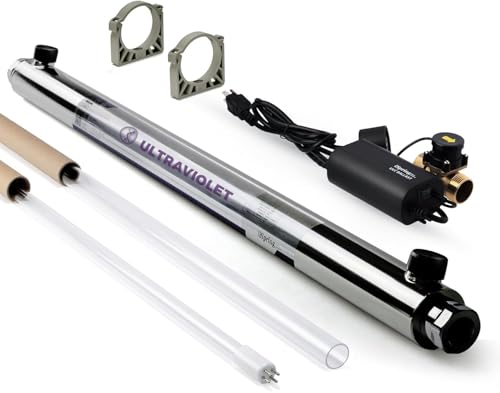
iSpring UVF55FS Whole House UV Water Filter, 12 GPM, 1 Inch Ports
$299.99 Published specsA 12 GPM whole house ultraviolet system with a flow sensor, inactivating bacteria and other organisms with a measured light dose and removing nothing chemically.
Best for: A budget whole house ultraviolet installation
Check price on AmazonReverse osmosis and ultraviolet are not competing purchases, and choosing one instead of the other because it looked like the more advanced option is a common and expensive mistake. Reverse osmosis rejects dissolved contaminants across a semipermeable membrane and does essentially nothing to organisms it has not been specifically certified against. Ultraviolet inactivates organisms with a measured light dose and removes nothing from the water at all, so every dissolved contaminant already present passes straight through it unchanged.
That difference is not a minor technical footnote, it is the entire comparison. A household that installs an ultraviolet system on a well that also tests high for arsenic has treated exactly none of the arsenic. A household that installs reverse osmosis on a well that tests positive for coliform bacteria has treated exactly none of the bacteria risk in water drawn anywhere else in the house. The two technologies are complements aimed at two different categories of problem, chemistry and biology, and a private well with both a chemical result and a biological result on its lab report typically needs both.
What does reverse osmosis actually remove
A reverse osmosis membrane forces water through a barrier fine enough to reject a large share of dissolved solids, which is why the technology is certified under NSF/ANSI 58 for total dissolved solids reduction. Beyond the baseline TDS claim, a specific model can carry additional certified claims, most commonly arsenic V or lead, but only where that exact model has been tested and certified for that exact contaminant. The iSpring RCC7 5 Stage Under Sink Reverse Osmosis System states its NSF/ANSI 58 certification plainly on the listing rather than leaving the reader to assume what certified means. Reverse osmosis membranes are a chemistry tool. They were never designed as, and are not generally certified as, a disinfection step against bacteria or viruses, and a household relying on one for that job is relying on something it was not built to do.
What does an ultraviolet system actually do to your water
Ultraviolet disinfection works on a completely different mechanism. A lamp inside a chamber delivers a measured dose of light as water passes through, and that dose damages the DNA of bacteria, viruses and protozoa so they cannot reproduce. NSF/ANSI 55 sets two classes: Class A delivers a minimum 40 mJ/cm2 and is rated for water not already known to be safe, while Class B delivers only 16 mJ/cm2 and is explicitly supplemental treatment for water already considered safe. Nothing about that process touches dissolved chemistry. Nitrate, arsenic, lead, fluoride and every other dissolved contaminant already in the water ahead of the lamp exits the chamber at the same concentration it entered, because ultraviolet removes nothing at all. The iSpring UVF55FS Whole House UV Water Filter, 12 GPM, 1 Inch Ports illustrates the mechanism well: a flow sensor and a rated GPM figure describe how much water the dose covers, not what the dose does to anything dissolved.
Side by side: chemistry versus biology
The two technologies do not overlap: NSF/ANSI 58 governs dissolved contaminant rejection, and NSF/ANSI 55 Class A requires a minimum dose of 40 mJ/cm2 for water not already known to be safe.
Published figure A published standard, regulatory limit, unit conversion or manufacturer specification. It does not change because somebody disagrees with it.
| Question | Reverse osmosis | Ultraviolet |
|---|---|---|
| What it changes | Dissolved chemistry, across a membrane | Biological activity, with a light dose |
| What it removes | TDS and, where certified, specific dissolved contaminants | Nothing chemically at all |
| Governing standard | NSF/ANSI 58 | NSF/ANSI 55, Class A or Class B |
| Typical dose or output | Rated in gallons per day at 60 psi and 77 degrees | Class A 40 mJ/cm2, Class B 16 mJ/cm2 |
| Produces wastewater | Yes, at a fixed drain ratio per membrane | No, none is discarded |
| Needs electricity | No, in most conventional tank systems | Yes, continuously while the lamp runs |
A specific reverse osmosis model can add a point of use ultraviolet stage after the membrane, which is a biological step layered onto a chemical one rather than either technology doing the other job.
Why some households need both, in that order
A private well is the clearest case for running both, because nobody tests it but the owner, and a single certified laboratory result can come back with both a chemical flag, such as arsenic or nitrate, and a biological flag, such as coliform bacteria. Where both are present, the two systems are typically installed for two different jobs rather than as a single stacked filter: an ultraviolet system near the point of entry, sized to the whole house peak flow, handles the biological result, while a dedicated reverse osmosis system at the kitchen sink handles the chemical result on drinking water specifically. The iSpring RCC7AK-UV 7 Stage Reverse Osmosis System with UV, NSF 58 and 372 Certified folds a point of use ultraviolet stage directly onto a reverse osmosis system, which suits a household that already has whole house ultraviolet and wants a second biological layer on the one tap used for drinking.
Frequently asked questions
Does reverse osmosis remove bacteria from water?
Residential reverse osmosis membranes are certified under NSF/ANSI 58 for dissolved solids reduction, not for biological disinfection, and a standard system should never be relied on to address bacteria. Bacteria, coliform in particular, is not a do it yourself topic. Confirming whether it is present at all needs a certified laboratory test, and a positive result needs a licensed well contractor or the local health department rather than a filter swap.
Will an ultraviolet system remove lead or arsenic from my water?
No. Ultraviolet disinfection inactivates organisms with a measured light dose and removes nothing chemically at all, so lead, arsenic and every other dissolved contaminant already in the water passes through the chamber unchanged. Confirming lead or arsenic needs a certified laboratory test, since both are invisible and tasteless, and addressing either one needs a reverse osmosis system with the matching certified claim rather than a lamp.
Do I need both reverse osmosis and ultraviolet?
Only your test results can answer that. A certified laboratory result showing a dissolved contaminant such as nitrate or arsenic points toward reverse osmosis with the matching certified claim, while a positive bacteria result points toward ultraviolet, usually alongside a licensed professional addressing the well itself. Plenty of households need only one, and installing either one without a lab result to justify it is spending money on an unmeasured problem.
What is the difference between NSF/ANSI 55 Class A and Class B ultraviolet?
Class A delivers a minimum dose of 40 mJ/cm2 and is rated for water not already known to be safe, which is the appropriate class for a well with an unresolved biological result. Class B delivers only 16 mJ/cm2 and is explicitly supplemental treatment for water already considered safe. The two look nearly identical on a listing, and choosing Class B for water that has tested positive for coliform is a genuinely dangerous mistake.
Can an ultraviolet stage be added after a reverse osmosis membrane?
Yes, and several under sink systems ship that way, adding a point of use ultraviolet lamp after the membrane as an extra biological layer on drinking water specifically. That is a useful configuration for a household that already has whole house ultraviolet and wants a second pass at the one tap used for drinking, but it is not a substitute for addressing a contaminated well at its source with a licensed professional.
Does a higher GPD rating on a reverse osmosis system mean better disinfection?
No. The gallons per day figure on a reverse osmosis membrane describes production speed at a laboratory reference pressure and temperature, and it has nothing to do with biological safety. A 90 GPD membrane rejects dissolved contaminants at the same certified level as a 50 GPD membrane of the same certification, just faster, and neither one is a disinfection claim of any kind.
Get the complete water treatment shopping list
Every item in the starter, complete and premium systems for both city water and well water, with running totals, in one printable list. It opens with the test kit, because that is genuinely the first purchase. No charge.
One list, no sequence of daily emails, and you can leave at any time.
Researched, not professional advice. This page is compiled from published standards, regulatory limits, manufacturer specifications and owner-review consensus, not hands-on testing. Nothing here diagnoses a water problem or says any product makes water safe to drink. Figures described as a rule of thumb are water treatment trade convention rather than published standards, and they are labeled that way wherever they appear. Test your water before you buy equipment: on city water start with the Consumer Confidence Report your utility publishes each year, and on a private well only a certified laboratory test tells you what you have. Bacteria, nitrate, lead, arsenic and PFAS are not do it yourself topics, they are invisible and tasteless, and they need a laboratory and usually a licensed professional rather than a product. Remember that a certification covers a specific claim under a specific standard, so "NSF certified" with no number attached tells you very little.