Iron, manganese and sulfur
Which iron filter is right for your well?
Quick answer
Well water iron needs a laboratory test before any filter, because clear water (ferrous), red water (ferric) and iron bacteria need three different fixes. Air injection systems like the DuraWater Fleck 5600SXT treat dissolved iron with no chemical feed, but oxidizing media only works inside its published pH window.
Iron is the largest well water complaint in the country, and it is also the well water problem people diagnose wrong most often. The reason is that "iron in the water" describes three genuinely different situations, each of which needs a different machine, and a filter bought for the wrong one either does nothing or fails within months.
There is no way to tell which form you have from a symptom alone. Clear water iron looks identical to no iron at all until the glass sits on the counter for an hour. A certified laboratory test that reports both total and dissolved iron, along with pH, is the only starting point that makes the rest of this page useful. The Environmental Protection Agency sets a secondary standard for iron at 0.3 mg/L, and secondary standards are aesthetic guidelines about staining and taste rather than enforceable health limits, so this is a comfort and plumbing question first.
Everything below assumes you have that number. If you do not, the first purchase is a test kit, not a filter, and buying equipment before the test is the single most expensive mistake in this category.
On this page
- What form of iron is actually in your well?
- Why can iron bacteria not just be filtered out?
- What does the EPA actually say about iron and manganese?
- Which oxidizing media matches your pH?
- Which iron filter should you buy on a tight budget?
- Which iron filter is the buy once, upgrade the weak point pick?
- Which iron filter handles the toughest wells, and who should skip it?
- Where does an iron filter go relative to a softener and a UV system?
- How do I size an iron filter without guessing?
- How we chose these products
What form of iron is actually in your well?
Get this wrong and every dollar spent afterward is wasted. The three forms behave, and are fixed, completely differently.
Clear water iron turns orange after standing, red water iron is already orange at the tap, and iron bacteria is a living colony that filters do not resolve.
Published figure A published standard, regulatory limit, unit conversion or manufacturer specification. It does not change because somebody disagrees with it.
| Form | What you see | What treats it |
|---|---|---|
| Clear water (ferrous, dissolved) | Clear at the tap, turns orange or rust colored after sitting in a glass or a toilet tank | Oxidizing filter or a softener rated for the ppm level |
| Red water (ferric, already oxidized) | Visibly orange or rusty the moment it leaves the tap, particles settle out | Sediment filtration ahead of anything else |
| Iron bacteria | Slimy orange or rust colored jelly in the toilet tank, on fixtures, or inside the pressure tank, often with an odor | Shock chlorination of the well, then retest |
Why can iron bacteria not just be filtered out?
What does the EPA actually say about iron and manganese?
Both are secondary contaminants, which changes what this page can honestly promise.
The EPA secondary standard is 0.3 mg/L for iron and 0.05 mg/L for manganese, and both are aesthetic guidelines rather than enforceable health limits.
Published figure A published standard, regulatory limit, unit conversion or manufacturer specification. It does not change because somebody disagrees with it.
| Contaminant | Secondary standard | What it governs |
|---|---|---|
| Iron | 0.3 mg/L | Rust staining, metallic taste |
| Manganese | 0.05 mg/L | Black staining, bitter taste |
Nothing here is a health effects claim. No filter on this page makes well water safe to drink; the standards above describe staining and taste, and bacteria, nitrate, lead, arsenic and PFAS are separate questions that need a certified laboratory test and usually a professional regardless of how the water looks.
Which oxidizing media matches your pH?
Media outside its published pH window simply does not work, and that is the usual reason an expensive iron filter disappoints.
Birm and air injection both need a pH of at least 6.8, manganese greensand works from about 6.2 but needs a higher pH for manganese, and Birm is destroyed by chlorine.
Published figure A published standard, regulatory limit, unit conversion or manufacturer specification. It does not change because somebody disagrees with it.
| Media | Minimum pH | Regenerant | Caution |
|---|---|---|---|
| Air injection | Roughly 6.8 | None, uses an air pocket | Handles hydrogen sulfide as well as iron |
| Birm | 6.8 | None | Destroyed by chlorine; wrong choice on a well that gets shock chlorinated |
| Manganese greensand | 6.2 for iron, higher for manganese | Potassium permanganate, an ongoing purchase | Regenerant has to be bought and handled by someone |
| Katalox Light | Wider range than Birm or greensand | None | A rebed option where the chemistry is awkward for the media above |
Which iron filter should you buy on a tight budget?
A cartridge based iron filter costs far less than a backwashing tank system, and it genuinely works at low measured iron levels. It also plugs quickly above that, so check your laboratory number before choosing this over a tank system.

H and G Lifestyles Whole House Iron and Manganese Filter System
$279.99The lowest cost dedicated iron treatment in this category, well below any backwashing tank system.
Check before buying: A cartridge based iron filter plugs quickly above a low iron level. Check your laboratory figure before choosing this over a backwashing filter.
Best for: A low measured iron level, confirmed by a lab test, where a full backwashing system is not yet justified
Check price on AmazonWhich iron filter is the buy once, upgrade the weak point pick?
A backwashing air injection or digital control filter is the durable answer once iron is measured above what a cartridge or a softener alone can carry. Air injection needs no chemical feed at all, which is why it is the default choice for most wells.
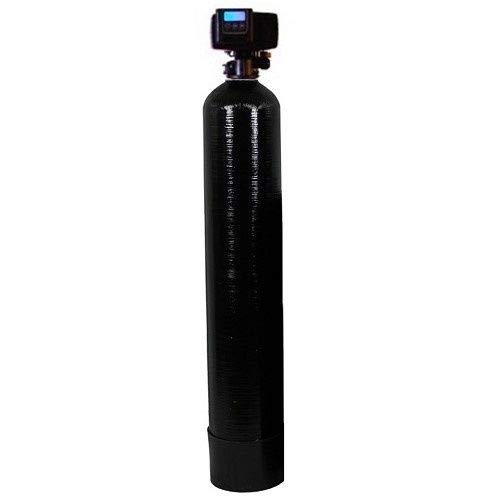
DuraWater Fleck 5600SXT Air Injection Iron Filter, 1.5 Cubic Foot
$899.00 Published specsRuns on the widely serviced Fleck 5600SXT valve, so parts and service are easy to find years from now.
Best for: Measured iron, manganese or a sulfur odor together, without a chemical feed to maintain
Check price on Amazon
iSpring WCFM400K Whole House Iron and Manganese Water Filter System
$1,097.25A digital control valve aimed specifically at iron and manganese, from a manufacturer with a direct support line.
Best for: Iron and manganese without a significant hydrogen sulfide smell
Check price on AmazonWhich iron filter handles the toughest wells, and who should skip it?
The largest air injection systems here exist for measured iron and sulfur levels well above what an entry unit is rated to handle. This is not a step to take on a guess.

AFWFilters Air Injection Platinum Iron, Sulfur and Manganese System, 1.5 Cubic Foot
$1,909.00The largest media bed and the highest published capability in this air injection range, rated up to 27 ppm iron.
Best for: A difficult well where a smaller unit has already failed to keep up
Check price on AmazonWho should not buy this tier: Anyone who has not had a full laboratory test including pH, because oxidizing media outside its pH window simply does not work and this is an expensive way to discover that. It is also not for iron bacteria, which needs shock chlorination first.
Where does an iron filter go relative to a softener and a UV system?
Order matters and it is not negotiable. Sediment filtration comes first to protect everything downstream, then oxidation and iron removal, then a softener if one is needed, then ultraviolet disinfection last, because UV needs the clearest water in the whole line to deliver its rated dose. Putting a softener ahead of an iron filter lets unoxidized iron fould the resin bed, and putting UV ahead of iron removal blocks the lamp behind stained, scaled quartz within months. See what order well water equipment should go in for the full sequence, and note that almost all of this equipment installs after the pressure tank rather than before it.
How do I size an iron filter without guessing?
Sizing runs off your laboratory ppm figure, not off how bad the staining looks.
The water treatment trade adds roughly 3 to 5 grains per gallon for every part per million of dissolved iron before sizing a softener, which is a rule of thumb rather than a published standard.
Rule of thumb Water treatment trade convention rather than a published standard. Taught everywhere, useful for planning, and not a specification. No standards body publishes it.
| Dissolved iron (ppm) | Added compensated hardness (gpg) |
|---|---|
| 1 | 3 to 5 |
| 3 | 9 to 15 |
| 5 | 15 to 25 |
This only applies to dissolved (ferrous) iron. Iron that is already oxidized or living as bacteria will foul resin rather than be exchanged by it, and no compensation figure changes that.
How we chose these products
We compared manufacturer published specifications, control valve platforms, and verified owner reviews rather than testing units in person. Every product linked here resolved against a live listing at the time of writing, and the ppm figures quoted for each system come from that manufacturer own claim, not from an estimate.
How we chose
We did not test this equipment in person and we never claim to. Picks are researched from manufacturer specification sheets, published standards and regulatory limits, and the recurring themes in verified owner reviews. Every pick is matched to a real grain capacity, a real micron rating, a real certified claim or a real flow rating rather than to a price bracket, and it is placed in the tier where its published capability actually belongs. We rejected the unbranded flood that dominates several of these search results, because a softener is a pressure vessel on the main line and a filter is the only thing between a contaminant and a glass of water, and neither is a place for a product with no parts channel and no service path. Where a figure is trade convention rather than a published standard we label it that way, and where a manufacturer does not publish a figure we leave it out instead of estimating it. Above all, we do not recommend equipment for a problem nobody has measured.
Sources
- EPA secondary drinking water regulations, iron and manganese
- Manufacturer published specifications for the air injection and media products linked on this page
Frequently asked questions
How do I know if my well iron is ferrous, ferric or bacteria?
A certified laboratory test reporting both total and dissolved iron tells ferrous from ferric, since dissolved iron that clears the tap and only turns orange after sitting is ferrous. Iron bacteria shows up as a slimy orange jelly in the toilet tank or pressure tank rather than as a water clarity issue, and confirming it usually needs a well inspection alongside the lab result rather than the test alone.
Can a water softener remove iron by itself?
A softener can handle a small amount of dissolved (ferrous) iron, commonly somewhere between 1 and 5 ppm depending on the specific unit published limit, but it does nothing for iron that is already oxidized and it fouls on iron bacteria. Running a softener near the top of its published iron rating shortens resin life gradually, which is easy to miss until capacity drops sharply.
Why does my Birm filter not seem to be working?
Birm needs dissolved oxygen present and a pH of at least 6.8 to oxidize iron, and it is destroyed by chlorine. If your well gets shock chlorinated periodically, or the water is low in dissolved oxygen, Birm is the wrong media regardless of how it is installed. A laboratory pH and dissolved oxygen reading, not a guess, decides whether Birm belongs in your system at all.
Is a positive iron bacteria test a bacteria in drinking water problem too?
Iron bacteria itself is generally not the pathogenic kind, but any well with an unexplained bacterial colony deserves a full certified laboratory panel including coliform, because iron bacteria and disease causing bacteria can share the same well conditions. Bacteria, nitrate, lead, arsenic and PFAS are never do it yourself topics, and a positive coliform result specifically needs your local health department and usually a licensed well professional.
Do I need potassium permanganate for every iron filter?
No. Only manganese greensand needs a potassium permanganate regenerant, which is an ongoing chemical purchase someone has to buy and handle correctly. Air injection filters and Birm need no chemical feed at all, which is why air injection dominates residential well installations where the pH and dissolved oxygen conditions allow it.
Will an iron filter fix a rotten egg smell too?
Sometimes. Several air injection filters, including ones on this page, are rated for hydrogen sulfide alongside iron and manganese, because the air oxidation process treats both. A filter built only for iron and manganese, without a hydrogen sulfide rating, will not resolve a sulfur odor, so check the specific ppm ratings on the listing before assuming one machine covers both problems.
Get the complete water treatment shopping list
Every item in the starter, complete and premium systems for both city water and well water, with running totals, in one printable list. It opens with the test kit, because that is genuinely the first purchase. No charge.
One list, no sequence of daily emails, and you can leave at any time.
Researched, not professional advice. This page is compiled from published standards, regulatory limits, manufacturer specifications and owner-review consensus, not hands-on testing. Nothing here diagnoses a water problem or says any product makes water safe to drink. Figures described as a rule of thumb are water treatment trade convention rather than published standards, and they are labeled that way wherever they appear. Test your water before you buy equipment: on city water start with the Consumer Confidence Report your utility publishes each year, and on a private well only a certified laboratory test tells you what you have. Bacteria, nitrate, lead, arsenic and PFAS are not do it yourself topics, they are invisible and tasteless, and they need a laboratory and usually a licensed professional rather than a product. Remember that a certification covers a specific claim under a specific standard, so "NSF certified" with no number attached tells you very little.