Testing
Which TDS meter should you actually buy?
Quick answer
A TDS meter measures conductivity and estimates total dissolved solids, not what is actually dissolved, so its real job is confirming a reverse osmosis membrane still rejects properly. The HM Digital TDS-3 is the reference handheld meter most owners use for that single check.
A TDS meter reads electrical conductivity and converts it into an estimate of total dissolved solids, and that is genuinely useful for exactly one job on this site: confirming a reverse osmosis membrane is still rejecting minerals the way it did when it was new. It is a poor tool for almost anything else, because conductivity says how much is dissolved and nothing whatsoever about what.
A low reading is not a safety result and a high reading is not automatically a problem. Well water with elevated arsenic can read a perfectly ordinary TDS number, and mineral rich city water can read high while every regulated contaminant sits comfortably under its limit. Bacteria, nitrate, lead, arsenic and PFAS are invisible to conductivity entirely, and none of them is a do it yourself topic: a certified laboratory test and usually a professional or the local health department is the only real answer for any of them.
We did not run any of these meters ourselves. We researched manufacturer published measurement ranges and a wide spread of verified owner reviews to build this list, and we say so plainly in the How we chose section below.
On this page
- What does a TDS meter actually measure?
- Where does a TDS meter genuinely earn its keep?
- Does a low TDS reading mean my water is safe, or a high one mean it has a problem?
- Does a TDS meter measure water hardness?
- Best TDS meter for a first check
- Best TDS meter for checking reverse osmosis performance
- Best next step once you have outgrown a TDS meter
- How we chose
What does a TDS meter actually measure?
Total dissolved solids is a proxy built on electrical conductivity. Dissolved minerals and salts conduct electricity, and a TDS meter reads that conductivity, then applies a conversion factor to display a number in parts per million or milligrams per liter. It is not a direct measurement of any specific mineral or contaminant, and two waters with an identical TDS reading can have completely different things dissolved in them.
Where does a TDS meter genuinely earn its keep?
NSF/ANSI 58 rates a reverse osmosis membrane's TDS rejection under a standardized feed of 250 mg/L at 60 psi and 77 degrees F, which is why a membrane's real world rejection on your own water can read differently from the number on the box.
Published figure A published standard, regulatory limit, unit conversion or manufacturer specification. It does not change because somebody disagrees with it.
| Standard test condition | Value |
|---|---|
| Feed water TDS | 250 mg/L |
| Pressure | 60 psi |
| Temperature | 77 degrees F (25 degrees C) |
A TDS meter on the permeate side of a membrane, compared against the feed side, is the standard way to check whether rejection has actually dropped since installation, and it is a genuinely useful maintenance check even though it is a poor safety test.
Does a low TDS reading mean my water is safe, or a high one mean it has a problem?
Does a TDS meter measure water hardness?
No. Total dissolved solids includes every dissolved ion, sodium and chloride along with calcium and magnesium, so a TDS reading cannot isolate hardness specifically. A softened house can show a similar or even higher TDS reading than before softening, because sodium replaced the hardness minerals rather than removing dissolved solids overall. For an actual hardness number, use a dedicated hardness test strip instead, not a TDS meter.
Best TDS meter for a first check
Both meters at this price point read the same underlying conductivity, so the choice comes down to a small feature difference rather than accuracy.
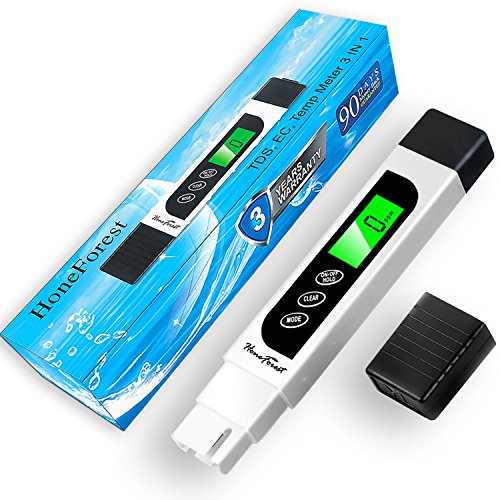
HoneForest TDS Meter, Digital Water Tester
$13.97Reads temperature alongside TDS, which matters because reverse osmosis output changes with feed water temperature.
Best for: Watching membrane performance and feed temperature together
Check price on AmazonBest TDS meter for checking reverse osmosis performance
This is the reference meter, and the one most reverse osmosis troubleshooting guides assume you own.

HM Digital TDS-3 Handheld TDS Meter, 0 to 9990 ppm
$14.50A hold function and auto shutoff aimed at a quick permeate versus feed comparison rather than continuous monitoring.
Check before buying: A TDS reading tells you how much is dissolved, not what. A low reading is not a safety result and a high reading is not automatically a problem.
Best for: Checking reverse osmosis performance before and after the membrane
Check price on AmazonBest next step once you have outgrown a TDS meter
Sometimes the honest upgrade is not a better meter at all.

Tap Score Ultimate Home Water Test Kit, 250 Plus Parameters
$399.95Once the real question is what is dissolved rather than how much, a certified laboratory panel answers it and a more expensive handheld conductivity meter does not.
Best for: A specific taste, odor or health concern a TDS reading cannot resolve
Check price on AmazonWho should not buy this tier: Skip this if the only question is whether your reverse osmosis membrane is still rejecting properly. Either meter above already answers that for under fifteen dollars, and no handheld meter at any price adds anything beyond a more precise version of the same conductivity estimate. A certified laboratory panel is worth the much higher price only when the actual question has moved past TDS entirely, to what is dissolved rather than how much.
How we chose
We did not run any of these meters ourselves. We researched manufacturer published measurement ranges and features, and a wide spread of verified owner reviews, weighted toward reviews that compare a meter reading against a reverse osmosis system's rated rejection rather than star ratings alone.
How we chose
We did not test this equipment in person and we never claim to. Picks are researched from manufacturer specification sheets, published standards and regulatory limits, and the recurring themes in verified owner reviews. Every pick is matched to a real grain capacity, a real micron rating, a real certified claim or a real flow rating rather than to a price bracket, and it is placed in the tier where its published capability actually belongs. We rejected the unbranded flood that dominates several of these search results, because a softener is a pressure vessel on the main line and a filter is the only thing between a contaminant and a glass of water, and neither is a place for a product with no parts channel and no service path. Where a figure is trade convention rather than a published standard we label it that way, and where a manufacturer does not publish a figure we leave it out instead of estimating it. Above all, we do not recommend equipment for a problem nobody has measured.
Sources
- HM Digital and HoneForest published measurement specifications
- NSF/ANSI 58 reverse osmosis standard test conditions
Frequently asked questions
What does a TDS meter actually measure?
A TDS meter reads electrical conductivity and converts that reading into an estimate of total dissolved solids, usually shown in parts per million or milligrams per liter. It is a proxy for how much is dissolved in the water, not a measurement of any specific mineral or contaminant, so two samples with an identical TDS reading can have entirely different things dissolved in them.
Does a low TDS reading mean my water is safe to drink?
No. A low reading only means conductivity is low, and neither nitrate, arsenic nor lead reliably raises conductivity enough to move a TDS number. Well water with an elevated regulated contaminant can read an entirely ordinary TDS value. Bacteria, nitrate, lead, arsenic and PFAS all need a certified laboratory test and usually a professional or the local health department, and a TDS meter answers none of that question.
Can a TDS meter test for lead, bacteria or other contaminants?
No. A TDS meter reads overall conductivity, not the identity of what is dissolved, so it cannot detect lead, bacteria, nitrate, arsenic or PFAS specifically. All five are not do it yourself topics regardless of what a TDS reading shows, and a certified laboratory test, usually alongside a licensed professional or the local health department, is the only way to check for any of them.
Does a TDS meter measure water hardness?
No. Total dissolved solids counts every dissolved ion together, sodium and chloride along with calcium and magnesium, so it cannot isolate hardness on its own. A house with a water softener can show a similar or higher TDS reading than before, since sodium replaces the hardness minerals rather than reducing total dissolved solids. Use a dedicated hardness test strip for an actual hardness number instead.
What TDS reading means my reverse osmosis membrane needs replacing?
Compare the permeate reading against the feed water reading rather than watching one number alone. NSF/ANSI 58 rates membrane rejection under a standardized 250 mg/L feed at 60 psi and 77 degrees F, and a meaningful drop in that rejection percentage over time, not a single reading, is what indicates the membrane needs replacing. The reverse osmosis production calculator on this site walks through that comparison.
Is there an EPA limit for total dissolved solids?
Only a secondary standard, not an enforceable limit. The EPA sets a secondary guideline of 500 mg/L for total dissolved solids, covering taste, scale and corrosion rather than health, so a reading above it is an aesthetic nuisance rather than a violation of anything enforceable. There is no maximum contaminant level for TDS the way there is for a regulated health contaminant.
Get the complete water treatment shopping list
Every item in the starter, complete and premium systems for both city water and well water, with running totals, in one printable list. It opens with the test kit, because that is genuinely the first purchase. No charge.
One list, no sequence of daily emails, and you can leave at any time.
Researched, not professional advice. This page is compiled from published standards, regulatory limits, manufacturer specifications and owner-review consensus, not hands-on testing. Nothing here diagnoses a water problem or says any product makes water safe to drink. Figures described as a rule of thumb are water treatment trade convention rather than published standards, and they are labeled that way wherever they appear. Test your water before you buy equipment: on city water start with the Consumer Confidence Report your utility publishes each year, and on a private well only a certified laboratory test tells you what you have. Bacteria, nitrate, lead, arsenic and PFAS are not do it yourself topics, they are invisible and tasteless, and they need a laboratory and usually a licensed professional rather than a product. Remember that a certification covers a specific claim under a specific standard, so "NSF certified" with no number attached tells you very little.