Reverse osmosis
How much water does an RO tank actually hold?
Quick answer
A 4 gallon reverse osmosis tank delivers about 2.6 gallons of usable water, roughly 65 percent of its nominal size. The air charge must be set with the tank empty, at 7 to 8 psi, and a wrongly charged tank is the usual cause of a trickle.
A reverse osmosis storage tank labeled four gallons does not hold four gallons of water. Inside is a bladder pressed against an air charge, and the system shuts off when tank pressure reaches roughly two thirds of feed pressure, so usable drawdown is normally about 60 to 70 percent of the nominal size.
The good news is that the commonest complaint about these systems, a faucet that gives a cupful and then trickles, is very often free to fix. It is usually the air charge rather than the membrane.
Work out your own drawdown
About 2.6 gallons usable from a 4 gallon tank, which is normal.
| Figure | Value |
|---|---|
| Nominal size | 4 gallons |
| Usable drawdown | 2.6 gallons |
| Against the label | 65% |
| System shuts off at | 40 psi tank pressure |
| Air charge | Correct |
Shown with the example figures above. Change any field to run your own numbers.
The working
Published figureusable drawdown = nominal size x usable fraction usable fraction is about 60 to 70 percent on a correctly charged tank, because the tank fills against its own air charge and the system shuts off at about two thirds of feed pressure air charge: 7 to 8 psi, SET WITH THE TANK EMPTY
The precharge figure and the shutoff behavior are published by tank and system manufacturers. A published standard, regulatory limit, unit conversion or manufacturer specification. It does not change because somebody disagrees with it.
Tanks and systems
Check the air charge before replacing anything. A tank that under delivers is far more often a wrong precharge than a failing membrane, and correcting it costs nothing.

APEC Water RO-90 5 Stage Under Sink Reverse Osmosis System, 90 GPD
$219.99A 90 GPD membrane, which fills the tank faster and matters more than it sounds on cold or low pressure supplies.
Best for: A household that empties the tank faster than a 50 GPD membrane refills it
Check price on Amazon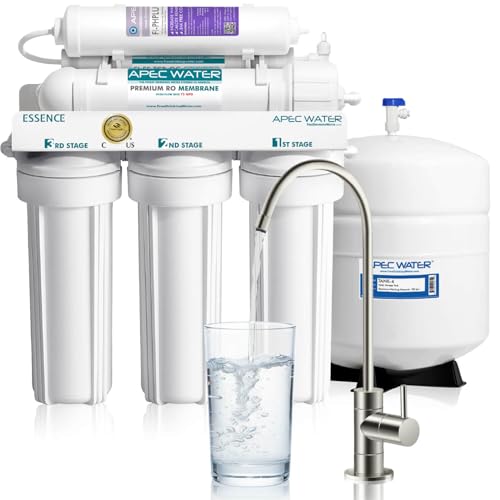
APEC Water ROES-PH75 6 Stage Under Sink RO System with Alkaline Stage, 75 GPD
$189.99 Published specsAdds a remineralisation stage after the membrane, which puts back some of the minerals reverse osmosis strips and changes the flat taste people complain about.
Best for: Anyone who tried reverse osmosis water and found it tasted flat
Check price on Amazon
APEC Water ROES-50 5 Stage Under Sink Reverse Osmosis System, 50 GPD
$179.99The most widely installed entry reverse osmosis system here, with standard sized cartridges that are available from many suppliers rather than one.
Best for: A first reverse osmosis system under a kitchen sink
Check price on Amazon
Max Water NSF Certified Reverse Osmosis Storage Tank, 4.4 Gallon, 100 PSI
$74.95States both an NSF certification and a 100 psi rating, which are the two figures that matter on a vessel holding drinking water.
Best for: An installation where the tank specification is being checked properly
Check price on Amazon
iSpring T55M Pre-Pressurised Water Storage Tank, 5.5 Gallon
$73.49A larger tank for a household that runs a standard four gallon tank empty, which is common with a slow membrane.
Best for: A household that regularly empties a four gallon tank
Check price on Amazon
iSpring T32M Pressurised Water Storage Tank with Ball Valve
$49.99Ships with the ball valve, which is the part needed to isolate the tank for a filter change or a pressure check.
Best for: A replacement tank where the old valve is seized
Check price on AmazonEvery figure shown is the manufacturer own published specification. None of this is a recommendation for water you have not tested: the arithmetic above is only as good as the numbers you put into it, and on a private well those numbers come from a certified laboratory rather than from a chart.
Why the label and the delivery differ
Usable drawdown is about 65 percent of the nominal size on a correctly charged tank at normal feed pressure.
Published figure A published standard, regulatory limit, unit conversion or manufacturer specification. It does not change because somebody disagrees with it.
| Nominal size | Low estimate | Typical | Best case |
|---|---|---|---|
| 2 gallons | 1.2 gal | 1.3 gal | 1.4 gal |
| 3.2 gallons | 1.9 gal | 2.1 gal | 2.2 gal |
| 4 gallons | 2.4 gal | 2.6 gal | 2.8 gal |
| 4.4 gallons | 2.6 gal | 2.9 gal | 3.1 gal |
| 5.5 gallons | 3.3 gal | 3.6 gal | 3.9 gal |
| 14 gallons | 8.4 gal | 9.1 gal | 9.8 gal |
The tank has to fill against its own air charge and the system stops producing at about two thirds of feed pressure, so some of the nominal volume is never water. This is normal behavior rather than a fault.
Setting the air charge, which is the part people get wrong
- Isolate and empty the tank. Close the tank valve, then open the reverse osmosis faucet and let it run until nothing more comes out. The charge MUST be set with the tank empty or the reading is meaningless.
- Read the pressure. Use a low range tyre gauge on the Schrader valve, usually under a cap at the bottom or side of the tank.
- Set it to 7 to 8 psi. Add air with a bicycle pump or bleed it down with the valve pin. Small changes matter, so work in single pounds.
- Reopen and refill. Open the tank valve and let the system refill, which takes a few hours. Then check the delivered volume into a measuring jug.
What each fault feels like
A tank charged too high fights the system and never fills; charged too low it holds water it cannot push back out.
Rule of thumb Water treatment trade convention rather than a published standard. Taught everywhere, useful for planning, and not a specification. No standards body publishes it.
| Symptom | Likely cause |
|---|---|
| Small amount then a trickle | Air charge too high, or feed pressure too low |
| Tank feels heavy but little comes out | Air charge too low or lost entirely |
| Water comes out of the Schrader valve | The bladder has ruptured. The tank needs replacing |
| Tank never fills at all | Feed pressure below about 40 psi, or a closed valve |
| Slow fill but full delivery | Normal on cold or low pressure supplies |
These are diagnostic conventions rather than published figures. Check the air charge before suspecting the membrane, because it is free and it is the commonest cause.
Frequently asked questions
How much water does a 4 gallon RO tank hold?
About 2.6 gallons of usable water on a correctly charged tank at normal feed pressure, roughly 65 percent of the nominal size. The tank fills against its own air charge and the system stops producing at about two thirds of feed pressure, so some of the nominal volume is never water.
What pressure should the air charge be?
7 to 8 psi, set WITH THE TANK COMPLETELY EMPTY. Checking it with water in the tank gives a meaningless reading, which is the commonest mistake. Use a low range tyre gauge on the Schrader valve and adjust in single pounds, because small changes make a noticeable difference.
Why does my RO faucet only give a cupful?
Usually the air charge rather than the membrane. If it is too high the tank fights the system and barely fills; if the bladder has ruptured, water comes out of the Schrader valve and the tank needs replacing. Low feed pressure below about 40 psi produces the same symptom. Check all three before buying anything.
Will a bigger tank fix slow delivery?
Only if you are genuinely running out of stored water. If the problem is flow rate rather than volume, a larger tank stores more of the same slow trickle and changes nothing. If it is low feed pressure, a booster pump or a tankless system is the answer, because the shutoff still trips at two thirds of a low feed pressure.
Do tankless systems avoid this entirely?
Yes, and it is one of their genuine advantages. With no storage tank there is no air charge to get wrong, no bladder to rupture and no drawdown arithmetic, and they free the cabinet space a tank occupies. The trade off is that they need mains electricity under the sink, which conventional systems do not.
Get the complete water treatment shopping list
Every item in the starter, complete and premium systems for both city water and well water, with running totals, in one printable list. It opens with the test kit, because that is genuinely the first purchase. No charge.
One list, no sequence of daily emails, and you can leave at any time.
Researched, not professional advice. This page is compiled from published standards, regulatory limits, manufacturer specifications and owner-review consensus, not hands-on testing. Nothing here diagnoses a water problem or says any product makes water safe to drink. Figures described as a rule of thumb are water treatment trade convention rather than published standards, and they are labeled that way wherever they appear. Test your water before you buy equipment: on city water start with the Consumer Confidence Report your utility publishes each year, and on a private well only a certified laboratory test tells you what you have. Bacteria, nitrate, lead, arsenic and PFAS are not do it yourself topics, they are invisible and tasteless, and they need a laboratory and usually a licensed professional rather than a product. Remember that a certification covers a specific claim under a specific standard, so "NSF certified" with no number attached tells you very little.