Hardness
What does 18 grains per gallon mean?
Quick answer
18 grains per gallon is 308 milligrams per liter, which the United States Geological Survey classifies as very hard. There is no EPA limit for hardness of any kind, because it is not a health contaminant: it is an appliance life, scale and laundry question.
Hardness is reported two ways and the two get confused constantly. A laboratory reports milligrams per liter as calcium carbonate; equipment is sized in grains per gallon. One grain per gallon equals 17.1 milligrams per liter, and that single conversion resolves most of the confusion in this category.
Hardness is calcium and magnesium dissolved in the water. It is not a contaminant in any regulatory sense, and that is worth saying plainly because a great deal of marketing implies otherwise.
On this page
Where this sits on the scale
At 18 grains per gallon, or 308 milligrams per liter, this water is classified as very hard.
Published figure A published standard, regulatory limit, unit conversion or manufacturer specification. It does not change because somebody disagrees with it.
| Classification | Grains per gallon | Milligrams per liter | |
|---|---|---|---|
| Soft | 0 to 1 | 0 to 17 | |
| Slightly hard | 1 to 3.5 | 17 to 60 | |
| Moderately hard | 3.5 to 7 | 60 to 120 | |
| Hard | 7 to 10.5 | 120 to 180 | |
| Very hard | over 10.5 | over 180 | Your water |
This is the classification laboratories and extension services use. It carries no regulatory force, because there is no regulation to carry.
There is no legal limit for hardness, and that is the point
The Environmental Protection Agency sets no maximum contaminant level for hardness and no secondary standard for it either. Hardness is not a health contaminant. Calcium and magnesium in drinking water are not harmful at any concentration found in a public supply, and in some studies hard water is associated with mildly favorable outcomes.
What hardness does is deposit scale when heated, which shortens the life of water heaters, blocks tankless heat exchangers and damages fixtures and valves. It also reacts with soap to form the film that makes hard water feel different and leaves spots on glassware. Those are real costs and they are worth spending money on. They are not safety costs, and any page that implies otherwise is selling something.
What 18 grains does in practice
At 18 grains per gallon this is not a preference question. Scale at this level shortens water heater life measurably, blocks tankless heat exchangers fast enough to void warranties that assume annual flushing, marks every fixture, and shortens the life of anything containing a solenoid valve, which means the dishwasher and the washing machine.
A four person household here removes 5,760 grains a day, which points at a 80,000 grain softener regenerating roughly weekly. Expect soap use to drop noticeably after treatment, which is the change most people report first.
Softener size at 18 grains, by household
At 18 grains per gallon a four person household removes 5,760 grains a day, pointing at a 80,000 grain nameplate.
Rule of thumb Water treatment trade convention rather than a published standard. Taught everywhere, useful for planning, and not a specification. No standards body publishes it.
| Household | Grains removed per day | Nameplate this points at |
|---|---|---|
| 1 person | 1,440 grains per day | 24,000 grains |
| 2 people | 2,880 grains per day | 40,000 grains |
| 3 people | 4,320 grains per day | 64,000 grains |
| 4 people | 5,760 grains per day | 80,000 grains |
| 5 people | 7,200 grains per day | 96,000 grains |
| 6 people | 8,640 grains per day | Beyond a single residential unit |
Calculated at 80 gallons per person per day, which is the conservative trade sizing figure rather than measured use, and at an efficient 8 pound salt dose with one day held in reserve.
Measure it first, then size the equipment
Chosen against the numbers on this page rather than from a general list, so the recommendation cannot contradict the arithmetic above. Every figure quoted is the manufacturer own published specification, and none of it is a recommendation for water you have not tested.

Varify Water Hardness Test Strips
$9.99Hardness is the one number on this site you can genuinely measure at home in thirty seconds, and it is the number that sizes a softener.
Best for: The first thing to buy before shopping for any softener
Check price on Amazon
Industrial Test Systems WaterWorks Total Hardness Test Strip
$16.99From a laboratory supply manufacturer rather than a consumer brand, which is the difference between a strip you can act on and one you cannot.
Best for: A hardness reading you intend to size equipment from
Check price on Amazon
Tier1 32,000 Grain Water Softener for 3 to 4 Bathroom Homes
$509.00Sold against bathroom count rather than grain capacity, which is how most people actually shop even though hardness is what decides the answer.
Check before buying: The bathroom count on the box is a flow rate guide, not a capacity guide. Size on your measured hardness and household size.
Best for: A three or four bathroom house that has measured its hardness first
Check price on Amazon
Aquasure Harmony Series 32,000 Grain Water Softener
$523.29 Published specsOne cubic foot of resin at the common entry nameplate, which suits a small household on genuinely moderate hardness and is undersized for much else.
Best for: One or two people on water under about 15 grains per gallon
Check price on Amazon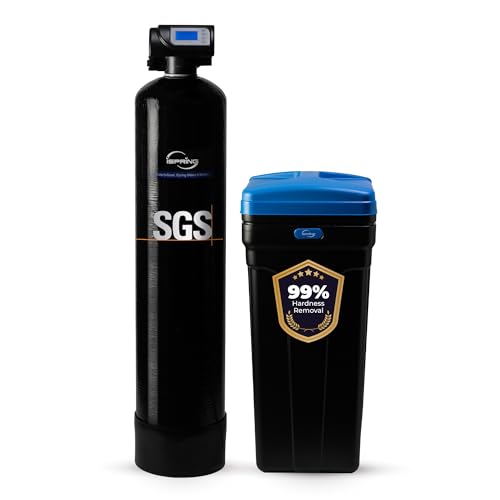
iSpring WCSTB45KG 45,000 Grain Water Softener with Brine Tank
$529.40A complete softener and brine tank at a lower entry price than the Fleck builds, from a manufacturer with a real support channel.
Best for: A first softener where budget matters more than valve serviceability
Check price on AmazonHow we chose
We did not test this equipment in person and we never claim to. Picks are researched from manufacturer specification sheets, published standards and regulatory limits, and the recurring themes in verified owner reviews. Every pick is matched to a real grain capacity, a real micron rating, a real certified claim or a real flow rating rather than to a price bracket, and it is placed in the tier where its published capability actually belongs. We rejected the unbranded flood that dominates several of these search results, because a softener is a pressure vessel on the main line and a filter is the only thing between a contaminant and a glass of water, and neither is a place for a product with no parts channel and no service path. Where a figure is trade convention rather than a published standard we label it that way, and where a manufacturer does not publish a figure we leave it out instead of estimating it. Above all, we do not recommend equipment for a problem nobody has measured.
Frequently asked questions
Is 18 grains per gallon hard water?
18 grains per gallon is 308 milligrams per liter, which the United States Geological Survey classifies as very hard. At this level scale is a genuine maintenance and appliance life issue rather than a cosmetic one.
How many ppm is 18 grains per gallon?
308 milligrams per liter as calcium carbonate, which is the same thing as parts per million for water. The conversion is 17.1 milligrams per liter per grain. Laboratories report in milligrams per liter and equipment is sized in grains, and confusing the two is the most common mistake in this category.
Is hard water bad for you?
There is no EPA maximum contaminant level for hardness and no secondary standard either, because hardness is not a health contaminant. Calcium and magnesium at the levels found in drinking water are not harmful. The costs are scale in water heaters and appliances, deposits on fixtures, and more soap used. Those are real, and they are not safety issues.
Do I need a softener at 18 grains?
At this hardness softening generally pays for itself in appliance life, particularly if you have a tankless water heater, which scales fast enough at this level to affect warranty conditions.
Will a filter reduce hardness?
No. Sediment and carbon filtration do nothing to hardness, because calcium and magnesium are dissolved rather than suspended. Only ion exchange softening removes hardness. Salt free conditioners change how the minerals deposit without removing them, so measured hardness is unchanged, and reverse osmosis removes it only at the one tap it serves.
Get the complete water treatment shopping list
Every item in the starter, complete and premium systems for both city water and well water, with running totals, in one printable list. It opens with the test kit, because that is genuinely the first purchase. No charge.
One list, no sequence of daily emails, and you can leave at any time.
Researched, not professional advice. This page is compiled from published standards, regulatory limits, manufacturer specifications and owner-review consensus, not hands-on testing. Nothing here diagnoses a water problem or says any product makes water safe to drink. Figures described as a rule of thumb are water treatment trade convention rather than published standards, and they are labeled that way wherever they appear. Test your water before you buy equipment: on city water start with the Consumer Confidence Report your utility publishes each year, and on a private well only a certified laboratory test tells you what you have. Bacteria, nitrate, lead, arsenic and PFAS are not do it yourself topics, they are invisible and tasteless, and they need a laboratory and usually a licensed professional rather than a product. Remember that a certification covers a specific claim under a specific standard, so "NSF certified" with no number attached tells you very little.