Whole house filtration
Which whole house water filter should you buy?
Quick answer
The best whole house water filter is sized on peak flow rather than household size: a Big Blue 4.5 by 20 inch housing passes up to 15 gallons a minute, while the standard 2.5 inch housing many starter kits ship with tops out near 6, which is the usual cause of a pressure complaint after installation.
A whole house water filter sits at the point where water enters the house, so every fixture depends on it passing enough flow. The failure people actually experience is not a taste complaint, it is a filter that cannot keep up: pressure drops the moment a second fixture runs, because the housing was chosen for the number of bedrooms rather than for gallons per minute.
The second thing worth getting right before spending anything is the claim on the box. A phrase like NSF certified names no standard and covers nothing specific. NSF/ANSI 42 is an aesthetic certification for chlorine taste and odor and particulate class. NSF/ANSI 53 is the certification that carries health claims such as lead, and it is certified claim by claim rather than for the unit as a whole. Below is a set of systems compared on published specifications and verified owner reviews rather than on marketing language, organized by the peak flow and the housing size that decides whether the house feels the filter at all.
On this page
- How is a whole house filter actually sized?
- How we chose
- Beginner: get a real two stage system for under 200 dollars
- Intermediate: the buy once three stage system
- Expert: a tank system that skips cartridge changes for a decade
- What does an NSF claim on one of these systems actually cover?
- Where does a whole house filter sit relative to a softener?
How is a whole house filter actually sized?
Sizing starts with peak simultaneous flow, not the number of people in the house. The trade plans on roughly 6 gallons a minute for one bathroom, climbing toward 14 for a house with four, and a soaking tub, a multi head shower or irrigation tied into the treated line pushes that higher. A filter chosen against household size rather than against that number is the one that starves the shower when the washing machine kicks on.
The housing decides the ceiling before the cartridge ever enters the conversation. A standard 2.5 inch housing and a 4.5 inch Big Blue housing look similar in a listing photo and pass very different flow. This is also why a filter that worked fine in a small starter home can choke a larger one even with the same cartridge inside it, because the surface area at the housing wall, not the media, is what limits gallons per minute.
A Big Blue 4.5 by 20 inch housing passes up to 15 gallons a minute, roughly double the standard 2.5 inch housing at the same length.
Published figure A published standard, regulatory limit, unit conversion or manufacturer specification. It does not change because somebody disagrees with it.
| Housing family | Cartridge size | Typical maximum flow |
|---|---|---|
| Standard, 10 in | 2.5 x 10 in | 6 GPM |
| Standard, 20 in | 2.5 x 20 in | 8 GPM |
| Big Blue, 10 in | 4.5 x 10 in | 10 GPM |
| Big Blue, 20 in | 4.5 x 20 in | 15 GPM |
Figures are manufacturer published maximums for the housing itself. The cartridge inside can still raise the pressure drop well below this ceiling.
How we chose
Every system below was compared on manufacturer published specifications, stage counts, port sizes and rated capacities, cross checked against verified owner reviews for the recurring complaints that a spec sheet does not show, mainly housing size mismatches and cartridge availability. Nothing on this page was installed or run in a house to test it. Where a claim depends on a specific NSF/ANSI standard, that standard is named rather than repeating the word certified on its own.
Beginner: get a real two stage system for under 200 dollars
A first whole house filter should solve one problem well, chlorine taste and light sediment on city water, without a big enough investment that a mistake is expensive. A two stage system in the standard housing size is the honest entry point for a small dwelling or an apartment.
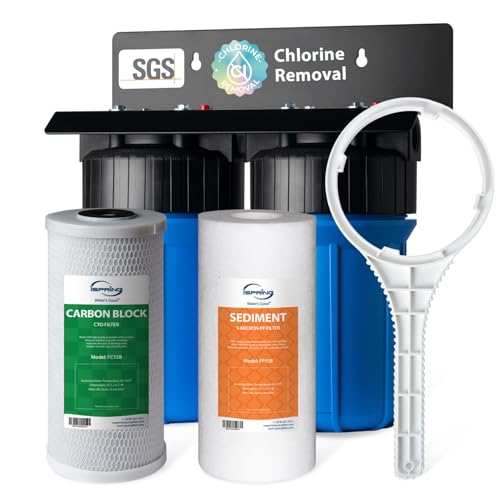
iSpring WGB21B 2 Stage Whole House Water Filtration System, 50,000 Gallons
$155.99A published 50,000 gallon capacity across two stages, at the lowest entry price in this category.
Best for: A small house or an apartment on city water with a straightforward taste complaint
Check price on AmazonIntermediate: the buy once three stage system
This is the tier most houses on city water actually need: three stages on Big Blue sized cartridges, so the housing itself is never the bottleneck and replacement cartridges are the widely stocked universal size rather than a proprietary one.

iSpring WGB32B 3 Stage Whole House Water Filter System
$420.00 Published specsSediment, then two carbon block stages, on one inch ports with a rated 15 gallon a minute flow and a 100,000 gallon capacity.
Best for: City water with a chlorine taste complaint and some particulate together
Check price on Amazon
Express Water 3 Stage Whole House Water Filter System
$493.19The same three stage idea in clear first stage housings, so the sediment cartridge loading is visible without opening anything.
Best for: Anyone who would rather see the cartridge than guess at a change date
Check price on AmazonExpert: a tank system that skips cartridge changes for a decade
A tank based carbon and KDF system trades a much higher upfront cost for a service interval measured in years rather than months, no draining or backwashing, and no cartridge to forget. It is a genuinely different piece of equipment from a cartridge system, not a nicer version of one.

Aquasana EQ-1000 Whole House Water Filter System, 1,000,000 Gallons
$1,123.00A million gallon rated tank of carbon and KDF media, which is roughly a decade for a typical household with no cartridge changes at all.
Best for: A household that would rather spend more once than think about filters twice a year
Check price on AmazonWho should not buy this tier: A rental, a house you may sell within a few years, or anyone unwilling to pay several times the cost of a cartridge system up front, because the payback is measured in years of avoided cartridges rather than in an immediate saving.
What does an NSF claim on one of these systems actually cover?
A listing that names iron, manganese or heavy metals is describing a specific cartridge stage, and the certified claim, if there is one, belongs to that exact model rather than to the phrase whole house filter in general. iSpring WGB32B-KS Heavy Metals Whole House Water Filter System adds a KDF stage aimed at heavy metals to the three stage platform, and the honest way to shop it is to look up whether that specific model carries an NSF/ANSI 53 certification for the metal you care about, lead in particular, rather than trusting the words heavy metals on the box.
Waterdrop WHF21-FG 2 Stage Whole House Water Filter System is certified to NSF/ANSI 372, which sounds like a safety claim and is a narrower one: it certifies the lead content of the wetted materials in the housing and cartridge shell, not that the filter removes lead from your water. Reducing lead already in your water is a certified performance claim under NSF/ANSI 53, and it needs to be checked separately for the exact model. Any concern about lead, or about bacteria, arsenic or PFAS in a supply, starts with a certified laboratory test rather than with a filter purchase, because none of those are visible or tasteless problems a cartridge change will announce.
Where does a whole house filter sit relative to a softener?
A whole house filter and a water softener do different jobs and neither substitutes for the other. Filtration handles taste, odor and particulate; nothing in a sediment or carbon cartridge touches dissolved hardness minerals, which pass straight through regardless of how fine the rating is. The usual plumbing order runs filtration first, softener second, so scale forming particulate does not load the resin bed. The full reasoning and the exceptions are in the softener versus whole house filter comparison linked below.
City water customers get a free annual measurement of exactly what is in the supply: the utility Consumer Confidence Report. Reading it before buying anything tells you whether the complaint is chlorine, chloramine, hardness or something else entirely, and it is the single highest value five minutes available in this category.
How we chose
We did not test this equipment in person and we never claim to. Picks are researched from manufacturer specification sheets, published standards and regulatory limits, and the recurring themes in verified owner reviews. Every pick is matched to a real grain capacity, a real micron rating, a real certified claim or a real flow rating rather than to a price bracket, and it is placed in the tier where its published capability actually belongs. We rejected the unbranded flood that dominates several of these search results, because a softener is a pressure vessel on the main line and a filter is the only thing between a contaminant and a glass of water, and neither is a place for a product with no parts channel and no service path. Where a figure is trade convention rather than a published standard we label it that way, and where a manufacturer does not publish a figure we leave it out instead of estimating it. Above all, we do not recommend equipment for a problem nobody has measured.
Frequently asked questions
What size whole house water filter do I need?
Size on peak simultaneous flow rather than household size. A house with one bathroom peaks around 6 gallons a minute, four bathrooms closer to 14, and a soaking tub or irrigation on the treated line pushes it higher. Match that number to the housing family: a Big Blue 4.5 by 20 inch housing passes up to 15 gallons a minute, while a standard 2.5 inch housing tops out near 6 to 8.
Does a whole house water filter remove hardness?
No. Sediment and carbon stages address particulate, taste and odor, and none of them touch dissolved hardness minerals at any micron rating. Hardness needs a water softener, which is a separate piece of equipment sized on grains per gallon rather than on flow. Running both in one system means filtration first, softening second, so particulate never reaches the resin bed.
What is the difference between NSF/ANSI 42 and NSF/ANSI 53?
NSF/ANSI 42 covers aesthetic effects: chlorine taste and odor and particulate class. NSF/ANSI 53 covers certified health claims, tested and listed one at a time, such as lead, cysts or volatile organic compounds. A filter can hold either, both, or neither, and the word certified alone tells you nothing until the standard number and the specific claim are named.
Will a whole house filter fix low water pressure?
Only if an undersized housing is the actual cause, which happens when a standard 2.5 inch housing is installed on a whole house feed that needs Big Blue flow. If pressure was fine before installation and drops afterward, the housing is the likely culprit. If pressure was already low throughout the house, the filter is not the fix and the plumbing or the well pump needs its own diagnosis.
How often do I need to change a whole house filter cartridge?
Watch pressure drop across the housing rather than the calendar or the rated gallons. A rise of 10 to 15 psi between the inlet and outlet gauge is the industry change point, because rated gallons are measured against a lab test challenge rather than your actual water. Carbon gives no such warning, since it exhausts chemically long before it restricts flow, so carbon stages are changed on gallons or a set date instead.
Can a whole house filter remove lead or bacteria?
Only a specific model certified to NSF/ANSI 53 for that exact claim addresses lead, and no whole house filter addresses bacteria at all, since that needs disinfection rather than filtration. Both are invisible and tasteless, so a certified laboratory test is the only way to know they are present, and a licensed professional or the local health department is the right next call before any equipment purchase.
Get the complete water treatment shopping list
Every item in the starter, complete and premium systems for both city water and well water, with running totals, in one printable list. It opens with the test kit, because that is genuinely the first purchase. No charge.
One list, no sequence of daily emails, and you can leave at any time.
Researched, not professional advice. This page is compiled from published standards, regulatory limits, manufacturer specifications and owner-review consensus, not hands-on testing. Nothing here diagnoses a water problem or says any product makes water safe to drink. Figures described as a rule of thumb are water treatment trade convention rather than published standards, and they are labeled that way wherever they appear. Test your water before you buy equipment: on city water start with the Consumer Confidence Report your utility publishes each year, and on a private well only a certified laboratory test tells you what you have. Bacteria, nitrate, lead, arsenic and PFAS are not do it yourself topics, they are invisible and tasteless, and they need a laboratory and usually a licensed professional rather than a product. Remember that a certification covers a specific claim under a specific standard, so "NSF certified" with no number attached tells you very little.