Softening
How to choose a water softener
Quick answer
Choose a softener from your measured hardness, not the number on the box: a family of four on water tested at 15 grains per gallon loads about 4,800 grains a day, and a 48,000 grain softener at an 8 lb salt dose regenerates roughly every 6 days, inside the weekly target most manufacturers plan around.
A water softener is one of the few purchases in this category where the box actively works against you. Every unit is labeled by its nameplate grain rating, 32,000, 48,000, 64,000, and that number is a ceiling reached only at the least efficient possible salt setting. Sizing off it alone routinely leads to a softener that regenerates far more often than the buyer was told to expect, burning through salt while still technically matching the number on the box.
The right starting point is not the box, it is your own water. Start with the hardness converter if your only figure is a Consumer Confidence Report in milligrams per liter rather than grains, then use the daily hardness load calculator to turn that number, plus your household size, into the actual daily grain load a softener has to remove. Everything below builds from that number rather than from a nameplate rating.
On this page
- The conversion that makes every softener spec sheet make sense
- How much softener capacity your household actually needs
- Why the nameplate number is a ceiling, not a working figure
- Beginner: lowest cost to something that measurably works
- Intermediate: the buy once pick for a serviceable valve
- Expert: chasing salt and water efficiency
The conversion that makes every softener spec sheet make sense
Laboratories report hardness in milligrams per liter as calcium carbonate. Every softener on the market is sized in grains. Confusing the two makes water look roughly 17 times harder than it actually is, because 1 grain per gallon equals 17.1 mg/L. A Consumer Confidence Report showing 171 mg/L of hardness is 10 grains per gallon, not 171.
Water above 10.5 grains per gallon (180 mg/L) is classified very hard, the point where nearly every household benefits from softening.
Published figure A published standard, regulatory limit, unit conversion or manufacturer specification. It does not change because somebody disagrees with it.
| Classification | Grains per gallon | Milligrams per liter |
|---|---|---|
| Soft | 0 to 1 | 0 to 17.1 |
| Slightly hard | 1 to 3.5 | 17.1 to 60 |
| Moderately hard | 3.5 to 7 | 60 to 120 |
| Hard | 7 to 10.5 | 120 to 180 |
| Very hard | above 10.5 | above 180 |
There is no EPA maximum contaminant level or secondary standard for hardness of any kind. It is not a health contaminant, and the USGS classification above is a description, not a regulatory limit.
How much softener capacity your household actually needs
Daily hardness load
Rule of thumbpeople x gallons per person per day x hardness in grains per gallon = daily grains a softener must remove
The trade sizes on 80 gallons per person per day as a deliberately conservative planning convention. Published end use studies measure closer to 59 gallons per person per day of actual indoor use, which is why sizing on the convention leaves headroom rather than running a softener at its ragged edge.
A family of four on moderately hard water, 6 grains per gallon, loads about 1,920 grains a day, before any dissolved iron is compensated for.
Rule of thumb Water treatment trade convention rather than a published standard. Taught everywhere, useful for planning, and not a specification. No standards body publishes it.
| Household | Hardness | Daily grain load |
|---|---|---|
| 2 people | 6 gpg | 960 grains/day |
| 4 people | 6 gpg | 1,920 grains/day |
| 4 people | 15 gpg | 4,800 grains/day |
| 6 people | 15 gpg | 7,200 grains/day |
Why the nameplate number is a ceiling, not a working figure
A "48,000 grain" softener contains 1.5 cubic feet of resin and reaches 48,000 grains only at the maximum published salt dose of 15 lb per cubic foot. Run the identical unit at a more efficient 8 lb dose and it delivers about 33,600 grains, using close to half the salt for roughly two thirds of the sticker capacity. This is the core fact the full grain capacity guide works through in detail, and it is why two buyers can own the same nameplate size and see very different regeneration schedules.
Beginner: lowest cost to something that measurably works
A first softener for a small household on genuinely moderate hardness does not need a large nameplate or a premium valve. It needs a metered control head, so it regenerates on water used rather than a fixed clock, and enough resin for the measured daily load.

Aquasure Harmony Series 32,000 Grain Water Softener
$523.29 Published specsOne cubic foot of resin at the common entry nameplate, with a digital metered control head as standard.
Best for: One or two people on water under about 15 grains per gallon
Check price on AmazonIntermediate: the buy once pick for a serviceable valve
The Fleck 5600SXT is the most widely serviced residential control valve in the country, which matters years after purchase when a part fails and you want a technician who already knows the valve rather than one learning it on your dime.
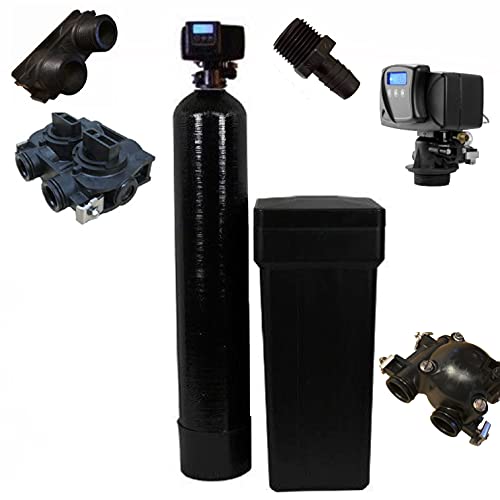
DuraWater Fleck 5600SXT 48,000 Grain Water Softener
$805.00 Published specsBuilt around the Fleck 5600SXT valve at the common 48,000 grain nameplate, with parts available nationwide for years to come.
Best for: A three or four bathroom house on moderately hard to hard city water
Check price on AmazonExpert: chasing salt and water efficiency
Efficiency focused softeners run upflow regeneration and a variable reserve that adapts to actual household patterns, aimed at reducing salt and water used per year rather than at a bigger sticker number.

SoftPro Elite Basic High Efficiency 48,000 Grain Water Softener
$1,289.00 Published specsBuilt around salt efficiency rather than nameplate capacity, with upflow regeneration and a published reduction in salt and wastewater use versus conventional units.
Best for: Somebody who cares more about salt and water used per year than the number on the box
Check price on AmazonWho should not buy this tier: A buyer comparing purely on sticker price, since the efficiency gain only pays back over years of reduced salt purchases, and a household with modest hardness that would never approach the standard unit limits in the first place.
How we chose
We did not test this equipment in person and we never claim to. Picks are researched from manufacturer specification sheets, published standards and regulatory limits, and the recurring themes in verified owner reviews. Every pick is matched to a real grain capacity, a real micron rating, a real certified claim or a real flow rating rather than to a price bracket, and it is placed in the tier where its published capability actually belongs. We rejected the unbranded flood that dominates several of these search results, because a softener is a pressure vessel on the main line and a filter is the only thing between a contaminant and a glass of water, and neither is a place for a product with no parts channel and no service path. Where a figure is trade convention rather than a published standard we label it that way, and where a manufacturer does not publish a figure we leave it out instead of estimating it. Above all, we do not recommend equipment for a problem nobody has measured.
Frequently asked questions
What size softener does a family of four actually need?
It depends entirely on your measured hardness, not on the family size alone. At a moderate 6 grains per gallon a family of four loads under 2,000 grains a day and a 32,000 grain unit comfortably clears a week between regenerations. At 15 grains per gallon the same family loads 4,800 grains a day, which pushes toward a 48,000 grain nameplate to stay inside the weekly target.
Should I size on the nameplate rating or the working capacity?
Working capacity, always. The nameplate figure is the ceiling at the least efficient salt dose the unit supports, not a number you will run at day to day. Size using the daily hardness load calculator against the working capacity at the salt dose you actually intend to program, typically 6 to 10 lb per cubic foot, rather than the number printed on the box.
Does having dissolved iron change what size I need?
Yes, and it needs a certified laboratory test to quantify rather than a guess. Dissolved, clear water iron adds roughly 3 to 5 grains of compensated hardness for every part per million present, so a softener sized on hardness alone is undersized on iron bearing well water. Above a manufacturer published iron limit, usually 1 to 5 ppm, a dedicated iron filter ahead of the softener becomes the right answer instead.
Is a bigger softener always the safer choice?
No. Oversizing means the unit regenerates on its forced cycle, typically every 7 to 14 days regardless of metered demand, rather than on genuine usage, and the extra resin simply sits unused between cycles. The honest goal is landing inside the 3 to 14 day regeneration window, ideally close to weekly, not maximizing the nameplate number.
Do I need a water softener at all if my water is only moderately hard?
Not necessarily. There is no EPA limit for hardness because it is not a health contaminant, so the decision is entirely about scale, soap use and appliance longevity rather than safety. Many households in the slightly to moderately hard range, roughly 1 to 7 grains per gallon, decide the cost and maintenance of a softener are not worth it and are not wrong to do so.
What is the difference between a single tank and a twin tank softener?
A single tank softener delivers untreated water for a short window during regeneration, usually scheduled overnight. A twin tank alternates between two resin beds so one stays in service while the other regenerates, giving continuous soft water at a meaningfully higher price. See the single versus dual tank comparison for who genuinely needs that continuity.
Get the complete water treatment shopping list
Every item in the starter, complete and premium systems for both city water and well water, with running totals, in one printable list. It opens with the test kit, because that is genuinely the first purchase. No charge.
One list, no sequence of daily emails, and you can leave at any time.
Researched, not professional advice. This page is compiled from published standards, regulatory limits, manufacturer specifications and owner-review consensus, not hands-on testing. Nothing here diagnoses a water problem or says any product makes water safe to drink. Figures described as a rule of thumb are water treatment trade convention rather than published standards, and they are labeled that way wherever they appear. Test your water before you buy equipment: on city water start with the Consumer Confidence Report your utility publishes each year, and on a private well only a certified laboratory test tells you what you have. Bacteria, nitrate, lead, arsenic and PFAS are not do it yourself topics, they are invisible and tasteless, and they need a laboratory and usually a licensed professional rather than a product. Remember that a certification covers a specific claim under a specific standard, so "NSF certified" with no number attached tells you very little.