Filtration
How to choose a whole house water filter
Quick answer
Choose a whole house filter by matching housing size to peak flow first, then staging sediment coarse to fine for your water source, then reading which specific NSF/ANSI standard and claim each cartridge holds. A 3 bathroom home needs about 10 GPM of capacity and, on well water, staging down to 5 micron rather than one fine cartridge alone.
Three decisions make or break a whole house filter purchase, and they happen in a fixed order. Flow comes first, because a filter that cannot pass your peak demand fails regardless of what it is certified to remove. Staging comes second, because jumping straight to a fine cartridge on water carrying visible grit plugs it in days rather than months. The specific certified claim comes third, because "filters contaminants" on a listing means nothing until you know which standard, which claim, and which model.
This guide walks all three in order. If you already know your peak flow number, see what size whole house water filter do I need for the full sizing math. What follows assumes flow is settled and focuses on what to actually buy once it is.
One thing this guide will not do is tell you a filter makes your water safe to drink. Whole house filtration addresses taste, odor, particulate and, for specific certified claims, named contaminants. It does not certify potability, and nothing on this page should be read that way.
On this page
Start from your water source, not the product page
City water and well water fail differently, and a filter chosen for one problem set is frequently the wrong answer for the other. City water almost always means a chlorine or chloramine taste complaint plus a small amount of fine sediment, since the utility already handled anything the Consumer Confidence Report would flag. Well water means unknown particle size, and iron or sulfur where the report from a laboratory test says so, which is a different filtration problem before taste ever enters the discussion.
Feeding visibly gritty well water straight into a fine carbon block, without a coarse stage ahead of it, is the single most common reason a whole house filter fails within weeks rather than lasting the rated year. Staging exists specifically to prevent that.
Well water carrying fine silt is staged in four steps, from 50 down to 1 micron, rather than filtered through one cartridge alone.
Rule of thumb Water treatment trade convention rather than a published standard. Taught everywhere, useful for planning, and not a specification. No standards body publishes it.
| Water condition | Staging, coarse to fine |
|---|---|
| City water, no visible sediment | 5 micron |
| City water, fine particulate or rust flakes | 20, then 5 micron |
| Well water, some sand or grit | 50, 20, then 5 micron |
| Well water, fine silt or turbidity | 50, 20, 5, then 1 micron |
This is trade practice rather than a published standard. A single graded density cartridge that steps from coarse to fine inside one housing achieves a similar effect to separate staged housings, at the cost of the ability to inspect and change each stage independently.
Nominal and absolute are not the same rating
A micron rating printed on a cartridge box means two different things depending on one word most people never read. An ABSOLUTE rating is defined: the cartridge removes at least 99.9 percent of particles at or above that size, tested against a defined challenge. A NOMINAL rating has no standardized definition at all. It generally implies something in the neighborhood of 85 percent removal, but the exact threshold is chosen by the manufacturer, so two cartridges both marked "5 micron nominal" can perform quite differently in practice.
This distinction matters most where a certified claim depends on it. A cyst reduction claim under NSF/ANSI 53 requires a 1 micron ABSOLUTE rating specifically. A cartridge marked 1 micron nominal does not meet that bar and must not be treated as though it does, whatever the box implies. See nominal versus absolute micron rating for the full comparison.
Read the standard number, not the word certified
"NSF certified" on a listing, with no number attached, tells you almost nothing, because a certification covers specific claims rather than the whole unit. A filter certified to NSF/ANSI 42 has been tested for taste, odor and chlorine reduction and for nothing else; it is not a lead claim, a cyst claim or anything health related, and treating it as one is exactly the marketing gap this table exists to close.
NSF/ANSI 42 covers taste and odor only; a certified health claim such as cyst reduction requires the separate NSF/ANSI 53 standard for that specific claim.
Published figure A published standard, regulatory limit, unit conversion or manufacturer specification. It does not change because somebody disagrees with it.
| Standard | What it covers | What it does not cover |
|---|---|---|
| NSF/ANSI 42 | Chlorine taste, odor, particulate reduction by class | Anything health related |
| NSF/ANSI 53 | Health effects, certified claim by claim: cysts, VOCs, chromium and others | Any claim the specific model was not individually tested for |
| NSF/ANSI 372 | Lead content of the fitting itself, at or below 0.25 percent | Removal of anything from the water |
Every certifier, NSF among several, publishes a searchable listing of exactly which model holds which claim. Looking a specific model up before buying is the single highest value five minutes available in this category.
Beginner: the lowest cost path to a working system
A first whole house filter on ordinary city water does not need multiple stages or a large rated capacity. It needs a housing sized correctly and a cartridge that addresses the actual complaint, which for most city water is chlorine taste rather than particulate.
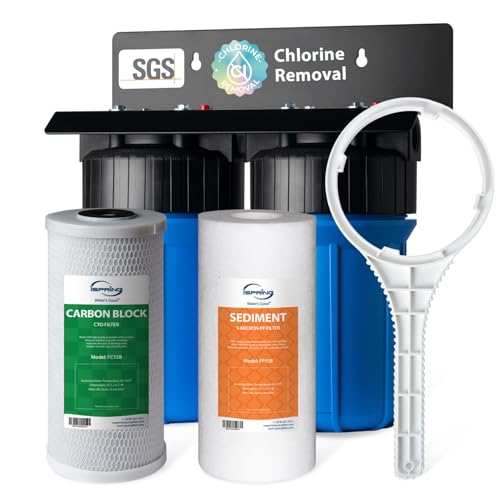
iSpring WGB21B 2 Stage Whole House Water Filtration System, 50,000 Gallons
$155.99Two stage sediment and carbon in the smaller 10 by 4.5 inch format, with a published 50,000 gallon rating.
Best for: A small house or apartment on city water with a straightforward taste complaint
Check price on AmazonIntermediate: the buy once pick for most houses
Once a house crosses into 3 or more bathrooms, or the water source is a well with a measured but modest sediment load, the reference three stage Big Blue platform is the honest default rather than an upgrade for its own sake.

iSpring WGB32B 3 Stage Whole House Water Filter System
$420.00 Published specsSediment plus two carbon block stages on 1 inch ports with a published service flow that actually clears whole house demand.
Best for: City water with a chlorine taste complaint and some particulate
Check price on AmazonExpert: the long service interval option
Tank based systems trade a higher upfront cost for a service interval measured in years rather than months, which pays back only if you stay in the house long enough to use it.

Aquasana EQ-1000 Whole House Water Filter System, 1,000,000 Gallons
$1,123.00A tank based carbon and KDF system rated at 1,000,000 gallons, roughly a decade for a typical household, with no cartridge changes on the main media bed.
Best for: A long term owner who would rather spend more once than replace cartridges twice a year
Check price on AmazonWho should not buy this tier: A rental property, a household expecting to move within a few years, or anyone whose only complaint is mild chlorine taste that a smaller cartridge system already resolves.
How we chose
We did not test this equipment in person and we never claim to. Picks are researched from manufacturer specification sheets, published standards and regulatory limits, and the recurring themes in verified owner reviews. Every pick is matched to a real grain capacity, a real micron rating, a real certified claim or a real flow rating rather than to a price bracket, and it is placed in the tier where its published capability actually belongs. We rejected the unbranded flood that dominates several of these search results, because a softener is a pressure vessel on the main line and a filter is the only thing between a contaminant and a glass of water, and neither is a place for a product with no parts channel and no service path. Where a figure is trade convention rather than a published standard we label it that way, and where a manufacturer does not publish a figure we leave it out instead of estimating it. Above all, we do not recommend equipment for a problem nobody has measured.
Frequently asked questions
Do I need a whole house filter if my city water report looks clean?
A clean Consumer Confidence Report means the utility met its regulatory limits, not that the water carries no chlorine taste or odor at your tap, since that report reflects the treatment plant rather than the last stretch of pipe into your house. Many city water buyers install a whole house filter purely for taste and chlorine reduction rather than because of anything the report flagged as a violation.
What is the real difference between 2 stage and 3 stage systems?
A 2 stage system is sediment plus one carbon stage, sized for a straightforward taste complaint on relatively clean water. A 3 stage system adds a second carbon block or a targeted media stage, which extends service life on water with a heavier chlorine or sediment load and is the more forgiving choice when you are not fully certain how demanding your water actually is.
Can one filter handle both city water and well water problems?
Not well. City water filtration is optimized around a light, predictable load, mostly chlorine and a little fine sediment. Well water is unpredictable and frequently needs coarse staging ahead of any fine cartridge. A system marketed for both usually compromises on one side, so matching the product line to your actual source is worth the extra research.
Is a KDF stage the same as a carbon stage?
No. Carbon media adsorbs organic compounds and chlorine by trapping them in its pore structure. KDF media works by a different chemical reaction, oxidation and reduction on a copper zinc alloy, and is often paired with carbon rather than used alone. A listing naming KDF is describing a specific added media, not a synonym for carbon filtration.
How often should I actually replace a whole house cartridge?
The rated gallons figure on the box is a manufacturer test result under a defined challenge, which makes it an upper bound rather than a promise for your specific water. The real trigger the industry uses is a rise of 10 to 15 psi in pressure drop across the housing, measured with a pair of gauges, since real sediment loading rarely matches the lab test conditions exactly.
Does a bigger rated gallon capacity mean better filtration?
Not necessarily. Rated capacity mostly reflects how much sediment or chlorine load the cartridge can absorb before it needs changing, which is a service interval question. The certified claim, and which specific standard backs it, is a separate and more important question when the goal is a named contaminant reduction rather than a longer time between cartridge changes.
Get the complete water treatment shopping list
Every item in the starter, complete and premium systems for both city water and well water, with running totals, in one printable list. It opens with the test kit, because that is genuinely the first purchase. No charge.
One list, no sequence of daily emails, and you can leave at any time.
Researched, not professional advice. This page is compiled from published standards, regulatory limits, manufacturer specifications and owner-review consensus, not hands-on testing. Nothing here diagnoses a water problem or says any product makes water safe to drink. Figures described as a rule of thumb are water treatment trade convention rather than published standards, and they are labeled that way wherever they appear. Test your water before you buy equipment: on city water start with the Consumer Confidence Report your utility publishes each year, and on a private well only a certified laboratory test tells you what you have. Bacteria, nitrate, lead, arsenic and PFAS are not do it yourself topics, they are invisible and tasteless, and they need a laboratory and usually a licensed professional rather than a product. Remember that a certification covers a specific claim under a specific standard, so "NSF certified" with no number attached tells you very little.