Reverse osmosis
What does a 75 GPD reverse osmosis membrane actually make at 35 psi?
Quick answer
A 75 GPD membrane at 35 psi with 60 degree feed water makes roughly 21.4 gallons a day, not 75. The rating is measured at 60 psi and 77 degrees Fahrenheit, which is a laboratory condition rather than a kitchen, and output falls with both pressure and temperature.
Almost every complaint that a reverse osmosis system "does not make as much water as advertised" traces to one fact: the gallons per day rating is measured at defined test conditions, about 60 pounds per square inch of feed pressure and 77 degrees Fahrenheit feed water, with low dissolved solids.
A real kitchen is colder and usually lower pressure than that. The rating is not dishonest, it is a standardized comparison figure, but it is a ceiling rather than an expectation.
The two corrections that matter
The working
Published figurepressure factor = feed psi / 60 psi = 35 / 60 = 0.58 temperature factor = about 3% lost per degree F below 77 F real output = rated GPD x pressure factor x temperature factor = 75 x 0.58 x 0.49 = about 21.4 gallons per day at 60 F
The test conditions are published by every membrane manufacturer. The temperature correction is membrane specific and each maker publishes its own table, so the three percent per degree used here shows the direction and rough size of the effect rather than specifying a particular membrane.
What feed water temperature does to output
Cold feed water is the reason a system slows in winter: the same membrane at the same pressure makes 8.8 gallons a day at 50 degrees against 43.8 at the test temperature.
Published figure A published standard, regulatory limit, unit conversion or manufacturer specification. It does not change because somebody disagrees with it.
| Feed temperature | Output against rating | Daily output |
|---|---|---|
| 50 F | 20% | 8.8 GPD |
| 55 F | 34% | 14.9 GPD |
| 60 F | 49% | 21.4 GPD |
| 65 F | 64% | 28.0 GPD |
| 70 F | 79% | 34.6 GPD |
| 77 F | 100% | 43.8 GPD |
Membrane flux falls with temperature because the water is more viscous and diffuses through the membrane more slowly. Nothing is wrong with a system that slows down in winter and recovers in summer.
How much goes to drain
A conventional tank system recovers about 20 percent, which is four gallons to drain for every gallon produced. A high recovery tankless system roughly halves that.
Published figure A published standard, regulatory limit, unit conversion or manufacturer specification. It does not change because somebody disagrees with it.
| System type | Recovery | Drain to product ratio | Drain water per day here |
|---|---|---|---|
| Conventional tank system | 20% | 4.0 to 1 | 85.6 gallons |
| Efficient tank system with permeate pump | 33% | 2.0 to 1 | 43.4 gallons |
| Tankless high recovery system | 50% | 1.0 to 1 | 21.4 gallons |
The drain water is concentrate rather than waste in the usual sense: it carries away what the membrane rejected. A membrane run at too high a recovery scales and fails early, so the ratio is a design choice rather than pure inefficiency.
Systems and membranes around 75 GPD
Chosen against the numbers on this page rather than from a general list, so the recommendation cannot contradict the arithmetic above. Every figure quoted is the manufacturer own published specification, and none of it is a recommendation for water you have not tested.

APEC Water RO-90 5 Stage Under Sink Reverse Osmosis System, 90 GPD
$219.99A 90 GPD membrane, which fills the tank faster and matters more than it sounds on cold or low pressure supplies.
Best for: A household that empties the tank faster than a 50 GPD membrane refills it
Check price on Amazon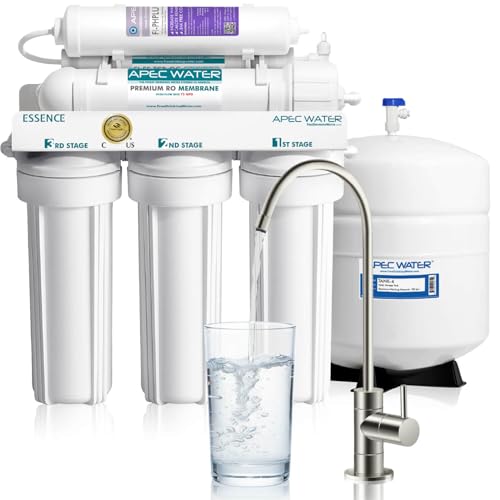
APEC Water ROES-PH75 6 Stage Under Sink RO System with Alkaline Stage, 75 GPD
$189.99 Published specsAdds a remineralisation stage after the membrane, which puts back some of the minerals reverse osmosis strips and changes the flat taste people complain about.
Best for: Anyone who tried reverse osmosis water and found it tasted flat
Check price on Amazon
iSpring RCC7AK 6 Stage Alkaline Reverse Osmosis System, 75 GPD
$234.99 Published specsThe six stage version with a remineralisation cartridge, at one of the lowest prices for that configuration.
Best for: Remineralised reverse osmosis water on a budget
Check price on Amazon
Waterdrop G3P600 Tankless Reverse Osmosis System, 600 GPD
$439.00A 600 GPD membrane producing on demand with no storage tank, which frees the cabinet space a four gallon tank takes up.
Best for: A small under sink cabinet, or a household that wants no storage tank at all
Check price on Amazon
Waterdrop G2 Tankless Reverse Osmosis System, 400 GPD
$249.99The lowest cost entry into tankless reverse osmosis, with a much better drain ratio than a conventional tank system.
Best for: A first tankless system where cabinet space is tight
Check price on Amazon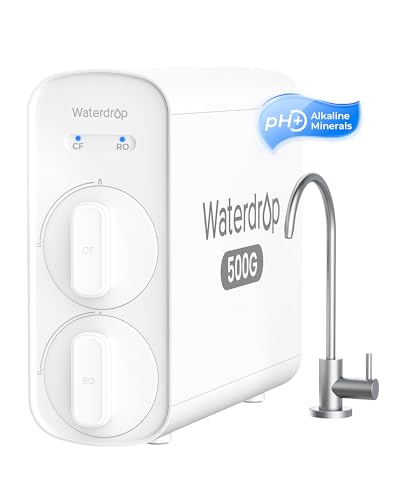
Waterdrop G5P500A Reverse Osmosis System, 8 Stage with Alkaline
$259.99 Published specsAdds remineralisation to the tankless platform, addressing the flat taste without going back to a tank.
Best for: Tankless reverse osmosis with the minerals put back
Check price on AmazonHow we chose
We did not test this equipment in person and we never claim to. Picks are researched from manufacturer specification sheets, published standards and regulatory limits, and the recurring themes in verified owner reviews. Every pick is matched to a real grain capacity, a real micron rating, a real certified claim or a real flow rating rather than to a price bracket, and it is placed in the tier where its published capability actually belongs. We rejected the unbranded flood that dominates several of these search results, because a softener is a pressure vessel on the main line and a filter is the only thing between a contaminant and a glass of water, and neither is a place for a product with no parts channel and no service path. Where a figure is trade convention rather than a published standard we label it that way, and where a manufacturer does not publish a figure we leave it out instead of estimating it. Above all, we do not recommend equipment for a problem nobody has measured.
Frequently asked questions
Why does my 75 GPD system not make 75 gallons a day?
Because the rating is measured at 60 psi and 77 degrees Fahrenheit with low dissolved solids, which is a laboratory condition. At 35 psi and 60 degree feed water the same membrane makes about 21.4 gallons a day. Nothing is faulty; the rating is a standardized comparison figure rather than a household expectation.
Does cold water really slow it down that much?
Yes. Membrane flux falls as water gets colder and more viscous, at roughly three percent per degree Fahrenheit below the test temperature. At 50 degree feed water this membrane makes about 8.8 gallons a day against 43.8 at the test temperature. A system that slows in winter and recovers in summer is behaving normally.
How much water goes down the drain?
A conventional tank system recovers about 20 percent, which is four gallons to drain per gallon produced. A permeate pump raises that to roughly a third, and a high recovery tankless system reaches about half. The drain stream is concentrate carrying away what the membrane rejected, and running a membrane at too high a recovery scales it and shortens its life.
Would a bigger membrane fix slow output?
Only if membrane area is actually the constraint. If feed pressure is low, and below about 40 psi it usually is, a larger membrane changes very little because the system still shuts off at two thirds of a low feed pressure. A booster pump or a tankless pumped system addresses the real limit. Check pressure at a hose bib before spending on a membrane.
Does reverse osmosis remove everything?
No, and the certification language matters. A system certified to NSF/ANSI 58 has been tested for total dissolved solids reduction, plus any optional health claims listed individually for that exact model. It is the main residential technology for dissolved contaminants such as nitrate and arsenic, but only where the model holds that specific claim, matched to a laboratory result.
Get the complete water treatment shopping list
Every item in the starter, complete and premium systems for both city water and well water, with running totals, in one printable list. It opens with the test kit, because that is genuinely the first purchase. No charge.
One list, no sequence of daily emails, and you can leave at any time.
Researched, not professional advice. This page is compiled from published standards, regulatory limits, manufacturer specifications and owner-review consensus, not hands-on testing. Nothing here diagnoses a water problem or says any product makes water safe to drink. Figures described as a rule of thumb are water treatment trade convention rather than published standards, and they are labeled that way wherever they appear. Test your water before you buy equipment: on city water start with the Consumer Confidence Report your utility publishes each year, and on a private well only a certified laboratory test tells you what you have. Bacteria, nitrate, lead, arsenic and PFAS are not do it yourself topics, they are invisible and tasteless, and they need a laboratory and usually a licensed professional rather than a product. Remember that a certification covers a specific claim under a specific standard, so "NSF certified" with no number attached tells you very little.