Softening
Which water softener should you actually buy?
Quick answer
A 48,000 grain nameplate softener holds 1.5 cubic feet of resin and delivers about 33,600 grains at an efficient 8 pound salt dose, enough to run roughly six days between regenerations for a family of four on 15 grain per gallon water. Test your hardness before sizing anything larger.
Every water softener on this list does the same basic job: it swaps calcium and magnesium ions for sodium ions as water passes through a bed of resin, and the resin gets rinsed clean with a brine solution once it fills up. The differences that actually matter are how much resin is in the tank, how the control head decides when to regenerate, and whether the nameplate number printed on the box has anything to do with what you will get in daily use.
That last part trips up more buyers than anything else in this category. Grain capacity is the total hardness a softener removes between regenerations, and it is quoted at the maximum salt dose the resin can be pushed to, not the dose most households actually run. Before any of the picks below, test your water. A city utility publishes hardness in its annual Consumer Confidence Report at no charge, and a well owner needs a hardness test strip at minimum, with a certified laboratory test for anything beyond hardness.
Nothing here is installed or run in a house we own. We compared manufacturer published specifications, control valve documentation and a wide spread of verified owner reviews to build this list, a different exercise from installing every unit ourselves, and we say so plainly in the How we chose section below.
On this page
- What does grain capacity actually mean, and why is the number on the box misleading?
- Best water softener for a first purchase
- Best water softener for most houses
- Best water softener for the last 10 percent
- Why SpringWell, Kinetico and Culligan softeners are not on this list
- Softener or salt free conditioner: are you solving the right problem?
- How we chose
What does grain capacity actually mean, and why is the number on the box misleading?
Grain capacity is the total hardness a softener removes between regenerations. The catch is that a cubic foot of standard resin does not deliver a fixed number of grains. It delivers a different number depending on how much salt is used to flush it, and the relationship is not a straight line: the last few thousand grains of capacity cost a disproportionate amount of salt.
One cubic foot of standard resin delivers about 20,000 grains at an efficient 6 pound salt dose per cubic foot, and only reaches roughly 30,000 grains at the 15 pound dose most nameplate ratings are built on.
Published figure A published standard, regulatory limit, unit conversion or manufacturer specification. It does not change because somebody disagrees with it.
| Salt dose (lb per cu ft) | Grains delivered per cu ft | Grains removed per pound of salt |
|---|---|---|
| 6 | 20,000 | 3,333 |
| 8 | 22,400 | 2,800 |
| 10 | 24,000 | 2,400 |
| 12 | 27,000 | 2,250 |
| 15 (typical nameplate max) | 30,000 | 2,000 |
A softener sold as a "32,000 grain" unit holds one cubic foot of resin and only reaches that number at the 15 pound dose. Run it at an efficient 6 pounds and it delivers about 20,000 grains instead, and it is worth noticing that even the most efficient row here sits just under the 3,350 grains per pound NSF/ANSI 44 sets as its high efficiency threshold, which is why softeners marketed as high efficiency use a lower dose still or a different resin, not the standard curve above.
Best water softener for a first purchase
A first softener should cost as little as possible while still being sized against a real hardness number, not a guess. Both picks below are single tank metered units with a lower nameplate rating, which matches a smaller household or moderate hardness rather than a five bedroom house on 25 grain water.
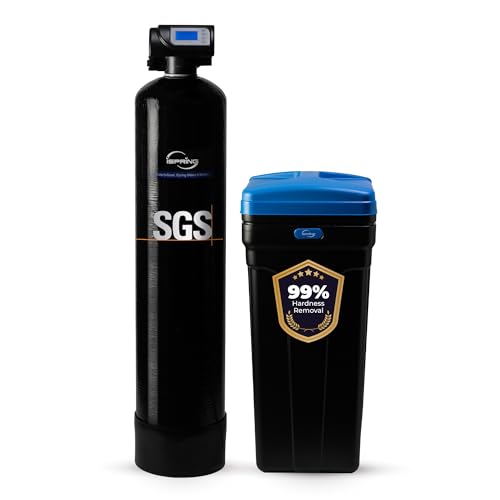
iSpring WCSTB45KG 45,000 Grain Water Softener with Brine Tank
$529.40The lowest entry price on this list for a complete metered softener with a matching brine tank included.
Best for: A first softener where budget matters more than long term valve serviceability
Check price on Amazon
Aquasure Harmony Series 32,000 Grain Water Softener
$523.29 Published specsA smaller nameplate from a brand with a wide service network, right sized for one or two people rather than oversold on capacity nobody needs.
Best for: One or two people on water measured under about 15 grains per gallon
Check price on AmazonBest water softener for most houses
This is the tier that fits a standard three to four bathroom house on moderately hard to hard water once it has actually been measured. Both picks use a metered digital valve rather than a timer, so regeneration tracks water used instead of a fixed schedule that wastes salt on a light week and comes up short on a heavy one.

Aquasure Harmony Series 48,000 Grain Water Softener
$629.99 Published specsThe 48,000 grain nameplate that shows up most often in verified owner reviews for a standard household, at a price that does not require a service contract to justify.
Best for: A three or four bathroom house on moderately hard to hard city water
Check price on Amazon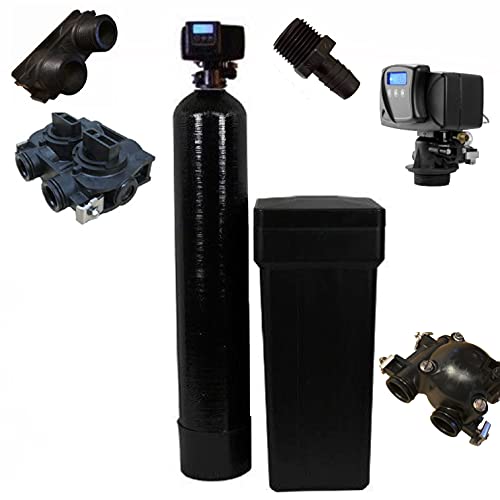
DuraWater Fleck 5600SXT 48,000 Grain Water Softener
$805.00 Published specsBuilt around the Fleck 5600SXT valve, which is the control head independent technicians can service for decades after the brand on the tank stops mattering.
Best for: Anyone who expects to still be servicing this softener in a decade
Check price on AmazonBest water softener for the last 10 percent
This tier chases either salt efficiency or zero soft water gaps, and it costs meaningfully more for both. Read the notFor line below before spending here, because a large share of households buying at this level do not actually need it.

SoftPro Elite Basic High Efficiency 48,000 Grain Water Softener
$1,289.00 Published specsA high efficiency valve engineered to regenerate on a lower salt dose than the standard curve above, aimed at cutting salt and water used per year rather than at raw capacity.
Best for: Somebody who cares more about salt and water used per year than about the sticker capacity
Check price on Amazon
DuraWater Fleck 9100SXT Twin Tank Water Softener, 48,000 Grain
$1,590.00 Published specsA twin tank system that keeps one tank in service while the other regenerates, so there is no window where the house runs on unsoftened water.
Best for: A household that genuinely uses water around the clock, or a well with limited recovery
Check price on AmazonWho should not buy this tier: Skip both of these if you are one or two people on water measured under about 15 grains per gallon. A single 32,000 or 40,000 grain metered softener regenerates on a normal weekly schedule for a fraction of the price, and neither the salt efficiency nor the zero gap benefit is worth paying for on a load that light.
Why SpringWell, Kinetico and Culligan softeners are not on this list
SpringWell is one of the most searched softener brands there is, and it is genuinely absent from this list on purpose rather than by oversight. SpringWell sells softeners through its own site rather than through the marketplace this list draws from, and the only SpringWell product actually available here is a whole house cartridge filtration system, which handles taste and sediment, not hardness. If the brand name is what you are searching for, see SpringWell's own softener lineup rather than assume a marketplace listing under that name is the real thing.
Kinetico and Culligan softeners are absent for the same structural reason: both sell through a local dealer network rather than direct online, so a softener listed under either name on a marketplace is not the equipment the brand actually installs. A Culligan filter housing does exist and is catalogued honestly as a housing, not a softener, further down this site.
Softener or salt free conditioner: are you solving the right problem?
A softener removes hardness minerals and replaces them with sodium, which is the only approach that changes a measured hardness number. A salt free conditioner does not remove anything and a lab test shows the same hardness before and after. If a floor drain or an HOA rule is standing between you and a conventional softener, read our salt free roundup before assuming this list is your only option, and see the full breakdown at salt versus salt free softeners.
How we chose
We did not install any of these softeners ourselves. We compared manufacturer published specifications, control valve documentation, warranty terms and a wide spread of verified owner reviews, weighted toward reviews that mention actual water hardness and household size rather than star ratings alone. Where a manufacturer did not publish a figure, that figure is left out rather than estimated, which is the same rule the rest of this site follows.
How we chose
We did not test this equipment in person and we never claim to. Picks are researched from manufacturer specification sheets, published standards and regulatory limits, and the recurring themes in verified owner reviews. Every pick is matched to a real grain capacity, a real micron rating, a real certified claim or a real flow rating rather than to a price bracket, and it is placed in the tier where its published capability actually belongs. We rejected the unbranded flood that dominates several of these search results, because a softener is a pressure vessel on the main line and a filter is the only thing between a contaminant and a glass of water, and neither is a place for a product with no parts channel and no service path. Where a figure is trade convention rather than a published standard we label it that way, and where a manufacturer does not publish a figure we leave it out instead of estimating it. Above all, we do not recommend equipment for a problem nobody has measured.
Sources
- Aquasure and DuraWater published specification sheets for the products listed above
- NSF/ANSI 44 summary of residential water softener performance and salt efficiency requirements
Frequently asked questions
What size water softener do I need?
Start from a measured hardness number, not a guess. Multiply people in the house by 80 gallons a day, the trade sizing convention, then by your grains per gallon to get a daily grain load. A softener should clear that load with room to regenerate every five to ten days rather than daily. The sizing calculator runs this for your household directly.
Is a 48,000 grain softener enough for a family of four?
Usually, but it depends entirely on your measured hardness. At 15 grains per gallon and an efficient 8 pound salt dose, a 48,000 grain nameplate delivers about 33,600 working grains and regenerates roughly every six days for a family of four, which fits comfortably inside the weekly target most manufacturers design around. Above about 25 grains per gallon, size up or consider a twin tank.
How often should a water softener regenerate?
Roughly once a week is the trade target. Much more often than every three days wastes salt and shortens resin life, and much less often than every ten to fourteen days lets the resin bed sit loaded and channel, which is why most control valves force a regeneration on that outer schedule regardless of metered demand.
Can I buy a SpringWell, Kinetico or Culligan water softener from this list?
Not a softener under any of those three names. SpringWell sells softeners directly rather than through the marketplace this list draws from, and its only listing here is a cartridge filtration system. Kinetico and Culligan both sell softeners through local dealer networks. A Culligan filter housing does appear elsewhere on this site, catalogued honestly as a housing rather than a softener.
What does NSF/ANSI 44 actually certify on a softener?
NSF/ANSI 44 covers residential softener performance, including a salt efficiency rating of at least 3,350 grains removed per pound of salt for a unit to be labeled high efficiency. That rating only holds at the salt setting the unit was certified at, so a high efficiency valve programmed to a maximum dose is not actually running at high efficiency.
Do I need a plumber to install a water softener?
Many owners install a single tank metered softener themselves if the house already has a drain and an electrical outlet near the intended location, since it is mostly two supply connections, a bypass valve and a drain line. A plumber earns their fee handling supply line modifications, a missing drain, or any work on well pressure tank plumbing, where a mistake affects the whole house.
Get the complete water treatment shopping list
Every item in the starter, complete and premium systems for both city water and well water, with running totals, in one printable list. It opens with the test kit, because that is genuinely the first purchase. No charge.
One list, no sequence of daily emails, and you can leave at any time.
Researched, not professional advice. This page is compiled from published standards, regulatory limits, manufacturer specifications and owner-review consensus, not hands-on testing. Nothing here diagnoses a water problem or says any product makes water safe to drink. Figures described as a rule of thumb are water treatment trade convention rather than published standards, and they are labeled that way wherever they appear. Test your water before you buy equipment: on city water start with the Consumer Confidence Report your utility publishes each year, and on a private well only a certified laboratory test tells you what you have. Bacteria, nitrate, lead, arsenic and PFAS are not do it yourself topics, they are invisible and tasteless, and they need a laboratory and usually a licensed professional rather than a product. Remember that a certification covers a specific claim under a specific standard, so "NSF certified" with no number attached tells you very little.